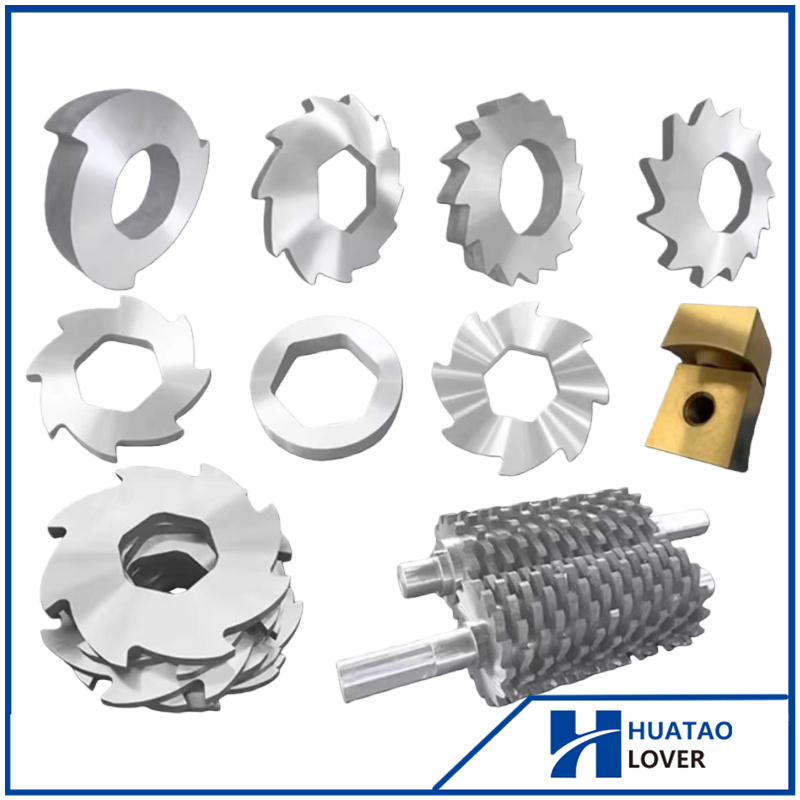
Shredder blades are the cutting components that determine the throughput, output quality, and operating cost of any shredding machine. A shredder is only as effective as its blades — dull or damaged blades increase energy consumption, reduce processing capacity, and produce inconsistent output. Huatao manufactures Shredder Blades for single-shaft and double-shaft shredders in a range of tool steel grades, configured to the specific demands of plastic, metal, tire, wood, and e-waste recycling applications.
Blade Material Selection
Material choice drives blade life far more than geometry . The correct steel grade depends on the feedstock being processed and the dominant wear mechanism — abrasion or impact.
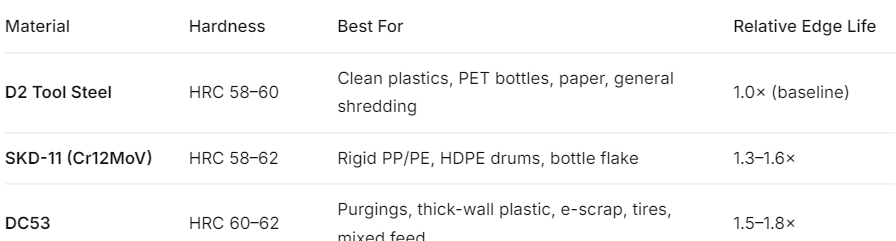
D2 is the workhorse grade for clean plastic recycling. It offers an excellent balance of wear resistance and cost. However, D2 is relatively brittle and can crack or shatter if heavy metal contaminants enter the shredder .
DC53 is a modified cold-work steel with approximately twice the toughness of D2. It resists chipping far better under impact, making it the preferred choice for e-scrap, tires, copper wire, and mixed plastic feed where shock loads are common .
SKD-11 sits between D2 and DC53 in performance, offering high wear resistance and dimensional stability for rigid plastic scrap and bottle flake .
For specific Huatao blade offerings, D2, H13, 55SiCr, and Cr12MoV grades are available depending on the application .
Blade Geometry and Configuration
Rotor Knives (Moving). The most common design is the square (4-way) blade, which allows the operator to rotate the blade 90 degrees when one edge dulls . Single-shaft shredder blades are typically square with curved edges on all four sides, a tapped hole in the middle, and a concave profile from edge to centre that grabs and tears material effectively .
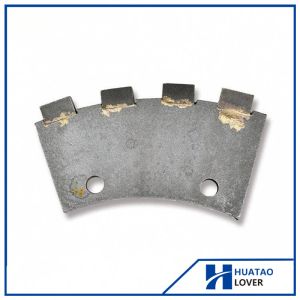
Stator Knives (Stationary). The fixed counter knife acts as the anvil. Stator knives should generally be 2–3 HRC softer than rotor knives, ensuring that in a crash, the cheaper and easier-to-change stator takes the damage rather than the expensive rotor .
Blade Dimensions. Double-shaft shredder blades are commonly available in diameters from 200mm to 500mm and thicknesses from 20mm to 55mm, with customization available .
Heat Treatment and Hardness
Two blades can look identical but perform differently due to heat treatment quality. Vacuum hardening followed by cryogenic treatment (freezing to -196°C) transforms retained austenite into martensite, increasing wear life by 20–30% without increasing brittleness .
Huatao blades are heat-treated to application-specific hardness targets. For general recycling, 58–60 HRC is typical. For impact-resistant grades like DC53, 60–62 HRC is achievable .
Applications by Shredder Type
Single Shaft Shredder Blades. Used in secondary reduction for plastics, wood, paper, and general waste. The blade rotates with the rotor and cooperates with a fixed blade to shred material through cutting, squeezing, and shearing.
Double Shaft Shredder Blades. Used in primary reduction for bulky, contaminated, or mixed materials. Double-shaft blades are engineered for high-torque tearing action and tolerate metal contamination, tires, e-waste, and construction waste.
Maintenance and Blade Life
Rotate, don't always sharpen. Most industrial shredder cutters have multiple usable edges. Rotating (indexing) the blade to expose a fresh edge is the normal maintenance routine. Shredder blades tear rather than slice, so they wear through chipping and rounding at the corners rather than a clean bevel wearing back .
When to sharpen. Sharpening is appropriate when wear is progressive and the cutting geometry can be restored without compromising the mounting interface. A surface grinder with coolant is required — never use a dry angle grinder, as localized heat will anneal the steel .
Contamination is the number one killer. Glass, sand, grit, metal, and stones are harder than blade steel. A shredder processing clean factory scrap may run blades for a year; the same machine processing post-consumer bales with sand and glass may consume a set in three months . Upstream magnetic separation and metal detection are essential protections.
Warning signs. Output quality drops before speed does — more fines, more uncut pieces, higher motor amps. Catching this early is cheap. Chips, cracks, or rounded corners are late, expensive signs that can escalate to bearing and rotor damage .
Contact Us
Ready to specify Shredder Blades for your machine and feedstock?