To choose an eddy current separator for an e-waste recycling line, first analyze your feedstock, particle size, metal liberation, ferrous contamination, and required processing capacity. Then compare magnetic rotor configurations, feeding systems, separation performance, maintenance requirements, and installation conditions.
The best machine is not necessarily the one with the highest rotor speed or lowest purchase price. It is the separator that achieves suitable metal recovery and concentrate purity under your actual operating conditions.
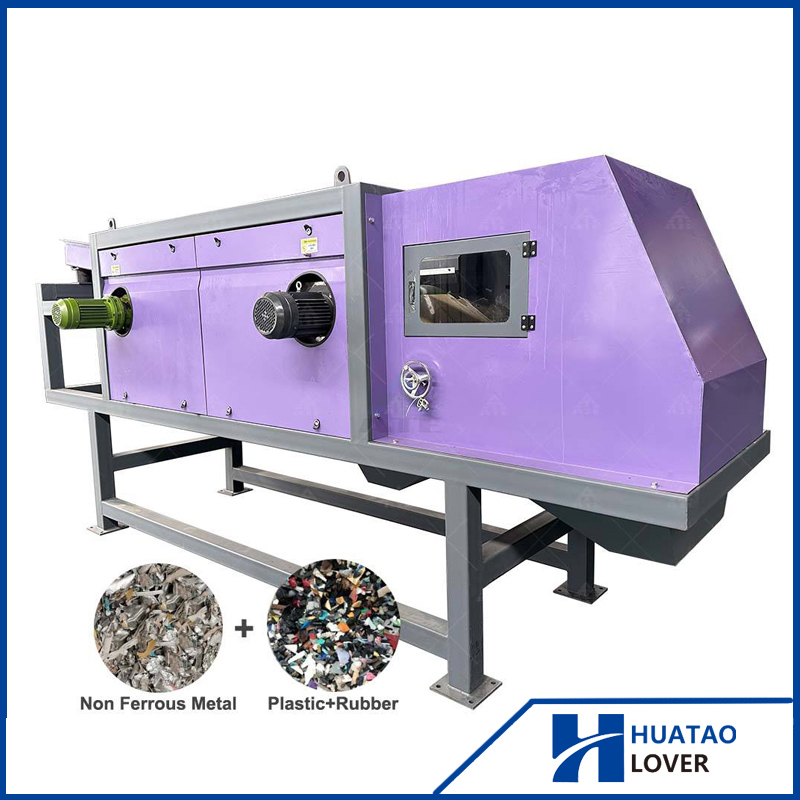
Why E-Waste Needs a Specialized Separation Solution
Electronic waste contains combinations of metals, plastics, glass, ceramics, and other materials. After shredding, valuable non-ferrous metals may be mixed with small non-metallic particles.
A properly selected Eddy Current Separator for E-Waste can recover suitable liberated aluminum, copper, brass, and other conductive particles.
However, electronic scrap differs from conventional metal scrap. Its particle sizes can be smaller, its material composition more variable, and its metal fragments more irregular.
These differences make careful equipment selection essential.
1. Identify Your Electronic Waste Materials
Begin by defining exactly what your plant will process.
Common materials include discarded appliances, circuit boards, shredded cables, computer components, and mixed WEEE fractions.
Each stream has different characteristics.
For example, cable granules may contain relatively uniform copper particles, while shredded appliances can contain mixed aluminum, plastics, steel, and other components.
Before comparing machines, prepare a basic feedstock analysis.
The ECS selection guide for recycling plants explains how material composition influences equipment configuration.
2. Match Rotor Design to Particle Size
Particle size directly influences separation behavior.
Large aluminum fragments may respond well to one rotor configuration, while fine copper pieces may require another.
For demanding applications, buyers should evaluate high-precision eddy current separators for electronic scrap.
Important parameters include magnetic pole arrangement, rotor speed, rotor geometry, conveyor speed, and splitter position.
Do not assume that a higher rotor speed automatically guarantees better recovery.
The correct configuration depends on the conductive properties, dimensions, and shape of the target particles.
3. Prepare the Feed Before the ECS
The separator's performance depends heavily on upstream processing.
A practical electronic waste recycling process may include safe dismantling, removal of hazardous components, primary shredding, secondary size reduction, screening, magnetic separation, and controlled feeding.
A double shaft shredder for e-waste recycling can help reduce bulky electronic components before downstream classification.
Screening can divide material into more consistent size fractions.
Ferrous metals should be removed before the ECS to reduce equipment risks and improve operating stability.
A complete e-waste recycling line engineering approach should consider how every processing stage affects the next.
4. Select the Correct Processing Capacity
Processing capacity should reflect the actual mass flow entering the separator.
A shredder's rated capacity is not necessarily the same as the ECS feed rate.
The system may remove steel, oversized pieces, and other fractions before material reaches the non-ferrous separation stage.
Consider conveyor width, feed-layer thickness, bulk density, moisture, and feeding consistency.
The guide to selecting an ECS by material size and throughput provides a useful framework.
An overloaded separator can suffer from particle overlap and reduced sorting accuracy.
5. Evaluate Metal Recovery and Product Purity
Buyers should request performance data rather than relying only on equipment descriptions.
Two important measurements are metal recovery rate and concentrate purity.
Recovery indicates the proportion of target metal captured. Purity indicates the proportion of desired material in the recovered concentrate.
A setting that improves recovery may also increase unwanted contamination.
For more application context, see copper and aluminum recovery from electronic scrap.
Representative testing should include a documented feed sample, operating throughput, output weights, and an assessment of metal losses.
6. Consider Maintenance and Operating Costs
Long-term costs include more than electricity and purchase price.
Review belt replacement, cleaning access, rotor maintenance, dust extraction, spare parts, and technical support.
A well-designed separator should also provide convenient adjustment of feeding, belt speed, and splitter settings.
Understanding the working principle and rotor design of an ECS helps buyers compare specifications more effectively.
7. Integrate the Separator into the Complete Line
The ECS should not be treated as an isolated machine.
Its performance is influenced by shredding, screening, magnetic separation, material feeding, and downstream refining.
HUATAO's industrial eddy current separator can be considered as part of a wider recycling system.
For facilities processing several types of waste, reviewing eddy current separator applications can also help identify process differences.
Frequently Asked Questions
Can an ECS recover copper from PCB waste?
Yes, when suitable conductive copper particles have been liberated from surrounding materials. Embedded metal may need additional processing.
Can the machine separate copper from aluminum?
A conventional ECS primarily separates conductive non-ferrous metals from non-conductive materials. Producing distinct copper and aluminum products may require additional separation equipment.
Is an ECS suitable for fine particles?
Specialized configurations may process fine fractions, but the practical lower particle-size limit must be established through testing.
Should magnetic separation come first?
Yes. Ferrous removal is an important upstream preparation stage.
What information should I send to the supplier?
Provide material photos, particle-size distribution, metal content, actual throughput, and target output specifications.
Conclusion
Selecting an ECS for electronic waste recycling requires an engineering approach based on real material conditions.
HUATAO supports recycling projects involving size reduction, material preparation, and non-ferrous metal recovery.
Related Products
-
Eddy Current Separator for E-Waste
-
Industrial Eddy Current Separator
-
High-Precision E-Waste ECS
-
Double Shaft E-Waste Shredder
-
E-Waste Recycling Line
Contact HUATAO
Email: marketing@huataogroup.com
Tel/WeChat/WhatsApp: 008613383116640
Website: www.huataoshredder.com
WhatsApp: http://wa.me/13383116640
#EddyCurrentSeparator #EwasteRecycling #WEEERecycling #ElectronicWaste #CopperRecovery #AluminumRecovery #MetalSeparation #RecyclingEquipment #RecyclingMachinery #RecyclingTechnology #IndustrialRecycling #CircularEconomy #ScrapRecycling #MaterialRecovery #WasteProcessing #RecyclingPlant #ElectronicScrap #NonFerrousMetals #WasteManagement #HUATAO



 WhatsApp