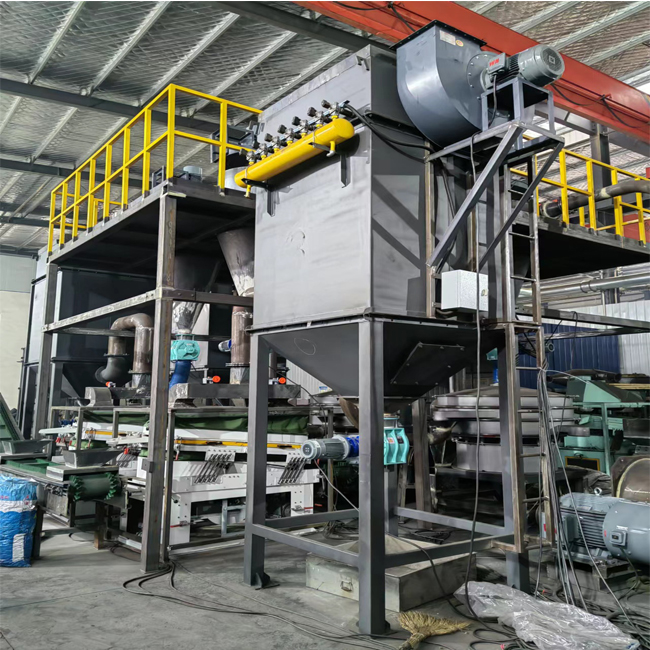
Electronic waste is not a waste stream in the conventional sense. It is an assembled product at the end of its service life — a deliberate construction of metals, polymers, ceramics, and glass, joined by fasteners, adhesives, and mechanical interlocks. The copper inside a printed circuit board did not arrive there by accident. It was engineered into position to perform a function. Recovering it requires reversing that engineering. And the HUATAO E-Waste Recycling Line is built around that reversal, stage by stage, from primary liberation to final separation.
Why E-Waste Requires a Dedicated Line
E-waste differs from other recycling streams in ways that directly affect equipment specification.
The metal particles are small. After size reduction, copper wire fragments, aluminium shards, and circuit board metallisation are typically measured in millimetres, not centimetres. Conventional separation equipment designed for municipal solid waste or automotive shredder residue operates effectively on particles of 5 mm and above. E-waste requires finer recovery .
The material is heterogeneous. A single feed stream may contain steel chassis components, aluminium heat sinks, copper windings, and metallised plastic — all mixed with non-conductive resin, fibreglass, and plastic housings. Each material requires a different separation mechanism.
And the value concentration is high. A single tonne of printed circuit boards contains more copper than several tonnes of copper ore, along with aluminium, brass, and precious metals . A small improvement in recovery rate translates directly into a significant revenue difference.-2
A HUATAO E-Waste Recycling Line is therefore not a generic shredding and separation system. It is a configured sequence in which each stage is selected against the liberation and purity requirements of the material it receives.
Stage One: Pre-Processing and Hazard Removal
The first operational step in an e-waste line is not shredding. It is assessment and hazard removal.
Electronic scrap contains components that must be removed before mechanical processing: batteries, capacitors with residual charge, mercury-containing backlights, and refrigerant circuits in appliances. These components pose fire, chemical, and environmental hazards, and their removal is both a safety requirement and a regulatory obligation in most markets .
Pre-processing also includes the removal of items that would damage the primary shredder or compromise downstream processes. Large electric motors, sealed compressors, and heavy transformers may be routed to separate processing streams. The objective is not to sort the material but to make it safe and suitable for mechanical reduction.
Stage Two: Primary Liberation and the Shear Principle
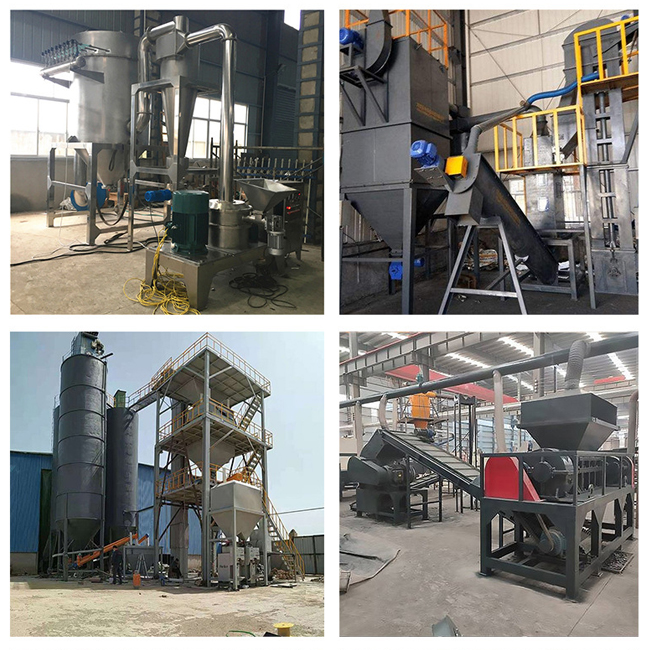
The primary reduction stage in the HUATAO E-Waste Recycling Line is performed by the Double Shaft Shredder.
The machine uses two counter-rotating shafts fitted with hardened cutting blades. Shaft speeds typically run in the range of 10 to 40 RPM, with torque multiplied through planetary gear reducers. There is no high-speed impact. The counter-rotating geometry creates a self-feeding effect, drawing material down between the shafts rather than allowing it to bounce on top.
This principle matters for e-waste because of the diversity of materials present. Impact-based reduction applies a single force profile to all of them, producing unpredictable results: brittle materials shatter into fines, ductile materials deform rather than break, and mixed assemblies may separate partially or not at all. Shear-based reduction applies sustained force until the material yields, regardless of whether it is brittle, ductile, or composite.
The output is a liberated mixture: metal fragments, plastic pieces, circuit board sections, cable segments, and mixed particles. The purpose of this stage is not uniform size reduction but liberation — breaking the mechanical connections between materials so that downstream separation can distinguish and separate individual fractions.
The HUATAO Double Shaft Shredder is manufactured in several capacity tiers for e-waste applications. The 800 Type Double Shaft Shredder suits mid-range operations. The 1000 Type Double Shaft Shredder and 1200 Type Double Shaft Shredder handle higher throughput requirements. A 600 Type Double Shaft Shredder is available for compact installations. Full specifications are on the Double Shaft Shredder Machine page. The Circuit Board Shredder page describes configurations specifically for PCB primary reduction.
Stage Three: Secondary Reduction and Size Control
The liberated mixture from the primary shredder is typically too coarse for effective separation. A secondary reduction stage produces the finer, more uniform particle size that separation equipment requires.
A Single Shaft Shredder performs this function within the HUATAO E-Waste Recycling Line. The machine applies controlled shearing against a fixed counter knife with a hydraulic pusher, producing consistent output through an interchangeable screen. The screen aperture determines the final particle size, allowing the line to be tuned to the downstream separation requirement.
Available single-shaft models include the Single Shaft Shredder HT600 Series, the 800 Type, the HT 1000 Type, and the 1200 Type.
The division of labour between the two stages is deliberate. The Double Shaft Shredder handles the difficult work of gripping and tearing bulky, irregular, contaminated material. The Single Shaft Shredder produces the controlled particle size that separation equipment requires. Attempting both functions with one machine produces compromises in both.
Stage Four: Ferrous Removal
The first separation stage in the HUATAO E-Waste Recycling Line is magnetic. An overband magnet or magnetic drum extracts ferrous metals — steel and iron — from the shredded stream.
The engineering significance of this stage extends beyond ferrous recovery. It also protects downstream equipment. Eddy current separators cannot process ferrous metals: the attractive forces on iron and steel are stronger than the repulsive Lorentz forces used in eddy current separation. If ferrous material enters the ECS, it is attracted to the rotor and disrupts the separation process .
This is why magnetic separation must always precede eddy current separation in an e-waste line. The recovered ferrous fraction is typically sold to steel mills as shredder feed.
Stage Five: Non-Ferrous Recovery and the Eddy Current Separator
Non-ferrous metals — aluminium, copper, brass, and zinc — are recovered using Eddy Current Separator technology. The ECS uses a high-speed magnetic rotor to induce eddy currents in conductive particles, generating a repulsive force that ejects non-ferrous metals from the material stream .
The effectiveness of this stage depends on three variables: particle size, liberation quality, and the absence of ferrous contamination. All three are determined upstream.
The defining technical challenge in e-waste eddy current separation is particle size. Shredded circuit boards and electronic components produce metal fragments that are frequently smaller than the effective range of conventional ECS designs. High-frequency eccentric rotor designs, with pole counts and rotational speeds optimised for fine particles, can recover non-ferrous metals down to approximately 1.5 mm in suitable configurations . Multi-pole rotor configurations and optimised magnetic field geometry improve the repulsive force applied to small particles.
For e-waste processors, the implication is clear: not every Eddy Current Separator is suitable for electronic scrap. The rotor configuration must be specified for the particle size distribution produced by the upstream shredding stage. Technical background is available in Eddy Current Separator for E-Waste: Recovering Copper and Aluminium from Electronic Scrap.
Stage Six: Further Refining and Output Handling
The remaining fraction after metal recovery consists primarily of plastics, glass, ceramics, and residual fines. Depending on the composition and market conditions, this fraction may be further processed to recover specific polymers, used as fuel in energy recovery applications, or disposed of as residual waste.
For higher-purity applications, sensor sorting or density separation may be added. The HUATAO E-Waste Recycling Line can be configured with these additional stages where the target output specification requires them.
Dust control is a critical consideration throughout the line. E-waste processing generates fine resin and metal dust, which is a key difficulty in factory operation. The complete line is equipped with pulse dust removal and negative pressure closed circulation systems, controlling dust overflow and helping enterprises pass environmental audits .
Complete Line Integration and Configuration
The HUATAO E-Waste Recycling Line is configured as a complete system rather than a collection of independent machines. The typical sequence is: pre-processing, primary shredding, secondary shredding, magnetic separation, eddy current separation, and further refining .
For complete e-waste line configurations, see E Waste Recycling Line High Purity Zero Discharge Systematic Solution and Circuit Board Crushing And Sorting Production Line. The broader Waste Recycling Production Line covers multi-stream applications, and HUATAO Configuring the Metal Recycling Line for Complex Feedstocks: From ELVs to E-Waste addresses e-waste within the wider metal recovery context .
Maintenance and the Liberation Variable
The HUATAO E-Waste Recycling Line operates in a high-wear environment. Glass, ceramics, and fibreglass-reinforced plastics are abrasive, and shock loads from unshreddable inclusions can damage blades and shafts.
Blade condition is the single most important variable. Dull blades do not simply reduce throughput. They produce a wider particle size distribution with more fines and more oversized fragments. That distribution degrades separation efficiency downstream, which means blade condition affects the performance of stages far removed from the shredder itself.
A structured maintenance programme is essential. The Twin Shaft Shredder Maintenance Guide Extend Service Life Cut Operational Cost sets out the recommended schedule. An Industrial Knife Grinding Machine restores blades to specification, and replacement blades are available as Huatao Wear Resistant Customization Shredder Blades.
Blade care guidance is available in Optimizing Shredder Blade Usage A Comprehensive Guide To Efficiency And Longevity and The Most Important Part Of Shredder Shredder Blades.
The Point
E-waste contains some of the highest concentrations of recoverable metals in any recycling stream. The HUATAO E-Waste Recycling Line is the mechanism that unlocks this value — from primary liberation through ferrous removal, eddy current recovery, and final output handling.
Each stage is configured to the requirement of the next. The shredder is selected for the liberation requirement of the magnetic separator. The magnetic separator is selected for the purity requirement of the eddy current separator. The eddy current separator is selected for the particle size distribution produced upstream.
When this sequence is followed, the line performs as designed. When it is not, the weakest interface sets the ceiling for the entire operation.
Contact us:
Marketing@huataogroup.com
Tel:+86 13383116640 (WeChat/WhatsApp)
http://wa.me/13383116640
Website: www.huataoshredder.com
#HUATAO #EWasteRecyclingLine #EWasteRecycling #ElectronicScrap #DoubleShaftShredder #EddyCurrentSeparator #WEEERecycling #CircularEconomy #WasteManagement #RecyclingEquipment



 WhatsApp