A buyer comparing industrial shredder blades may see HRC 60, HRC 58 or another hardness value on a quotation or technical specification. It is natural to assume that the higher number represents a better blade.
But this is an incomplete way to evaluate cutting tools.
HRC 60+ does not automatically mean longer service life. Hardness measures resistance to indentation, while blade durability depends on several interacting properties, including toughness, wear resistance, heat treatment, cutting geometry and the operating environment.
A blade that resists abrasive wear may still be unsuitable if it chips under impact. A blade with good toughness may also wear too quickly if its material is not appropriate for the feedstock.
The right question is not simply how hard the blade is, but whether its properties match the machine and material.
1. What Is Shredder Blade Hardness?
Rockwell C hardness is a standardized method for evaluating resistance to indentation. It is commonly used when specifying hardened steel components and industrial cutting tools.
For shredder blades, hardness is relevant to surface deformation and wear behavior. However, it should not be interpreted as a direct measurement of cutting efficiency or service life.
A complete blade specification should also consider material grade, heat-treatment condition, dimensional accuracy and application requirements.
2. Hardness, Toughness and Wear Resistance Compared
| Property |
What it describes |
Why it matters |
| Hardness |
Resistance to indentation |
Helps assess resistance to deformation |
| Toughness |
Ability to absorb energy before fracture |
Relevant to impact and chipping risk |
| Wear resistance |
Resistance to material loss |
Relevant to abrasive operating conditions |
| Fatigue resistance |
Ability to withstand repeated loading |
Relevant to cyclic mechanical stress |
These properties are related, but they are not interchangeable.
A blade designed for abrasive feed may require a different property balance from one exposed to irregular, impact-heavy material.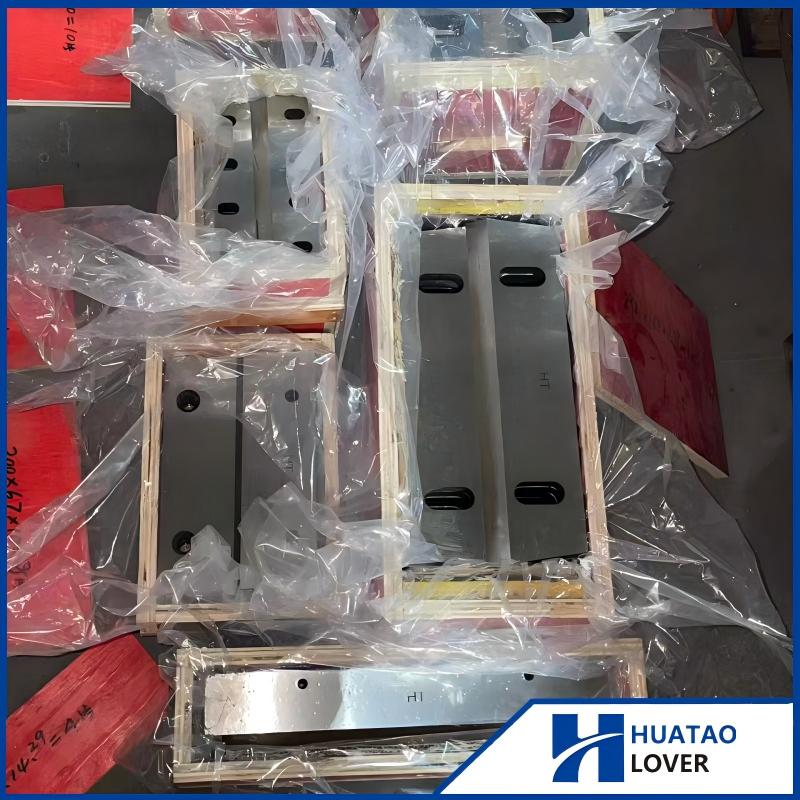
3. How Do Steel Grade and Heat Treatment Influence Performance?
Steel grade determines the material's potential characteristics. SKD11, D2 and DC53 are examples of tool steels used in industrial applications, but their performance should not be reduced to a simple hardness ranking.
Heat treatment then influences the final condition of the steel. Heating, quenching and tempering need to be appropriate for the selected material and blade requirements.
For procurement and quality-control teams, the following checks are useful:
-
Confirm the specified steel grade.
-
Request applicable material documentation.
-
Check the required hardness range.
-
Ask how hardness consistency is inspected.
-
Review the supplier's heat-treatment and quality-control procedures.
A hardness reading without material and process context is an incomplete basis for purchasing.
4. Application Conditions Change the Required Blade Properties
The feedstock is one of the most important factors in blade selection.
Plastic recycling, rubber processing, wood waste reduction and mixed industrial waste processing can expose blades to different combinations of abrasion, impact and cutting resistance.
Consider the following:
| Feed condition |
Engineering consideration |
| Clean, relatively consistent feed |
Cutting geometry and normal wear are important |
| Abrasive contamination |
Material wear resistance becomes a key consideration |
| Hard or irregular inclusions |
Impact resistance and toughness need attention |
| Variable feed size |
Cutting load and feeding stability may change |
| Long operating shifts |
Inspection and maintenance planning become more important |
A blade should be selected according to the real feed conditions, not only the material category printed on a purchase order.
5. Failure Analysis: What Does the Wear Pattern Tell You?
| Observed failure |
Areas to investigate |
| Gradual edge rounding |
Abrasive wear, material choice and maintenance |
| Localized edge chipping |
Impact, toughness and cutting conditions |
| Visible cracks |
Material condition, heat treatment, installation and abnormal loading |
| Uneven wear across blades |
Alignment, feeding distribution and blade clearance |
| Reduced cutting performance |
Edge condition, geometry and machine settings |
Do not assume that every chipped blade is caused by excessive hardness or that every worn blade needs a harder material. Inspection is necessary to identify the failure mechanism.
For operating context, review COMMON DOUBLE-SHAFT SHREDDER PROBLEMS.
6. How Should Buyers Specify Replacement Blades?
A useful RFQ should include:
-
Machine model and blade drawings
-
Blade dimensions and required quantity
-
Material being processed
-
Feed size and contamination
-
Required output size
-
Operating hours and production schedule
-
Current material and hardness specification, if available
-
Photos showing the existing blade condition
-
Main failure mode and replacement frequency
-
Sharpening and maintenance requirements
Ask the supplier whether it can manufacture to drawings, recommend a material based on the application, provide applicable documentation and explain its inspection process.
Where sharpening is part of the maintenance strategy, review AUTOMATIC LINEAR KNIFE SHARPENING EQUIPMENT and BLADE SHARPENING SOLUTIONS.
7. Maintenance and Service-Life Management
Even a correctly selected blade needs regular inspection. Operators should monitor edge condition, unusual noise, vibration, material buildup and changes in cutting performance.
Maintenance intervals should follow the machine manufacturer's recommendations and actual operating conditions.
A maintenance record should include operating hours, blade inspection results, sharpening history, replacement dates and the material being processed.
For more detailed guidance, see SHREDDER BLADE SERVICE-LIFE MAINTENANCE and CRUSHER BLADE WEAR.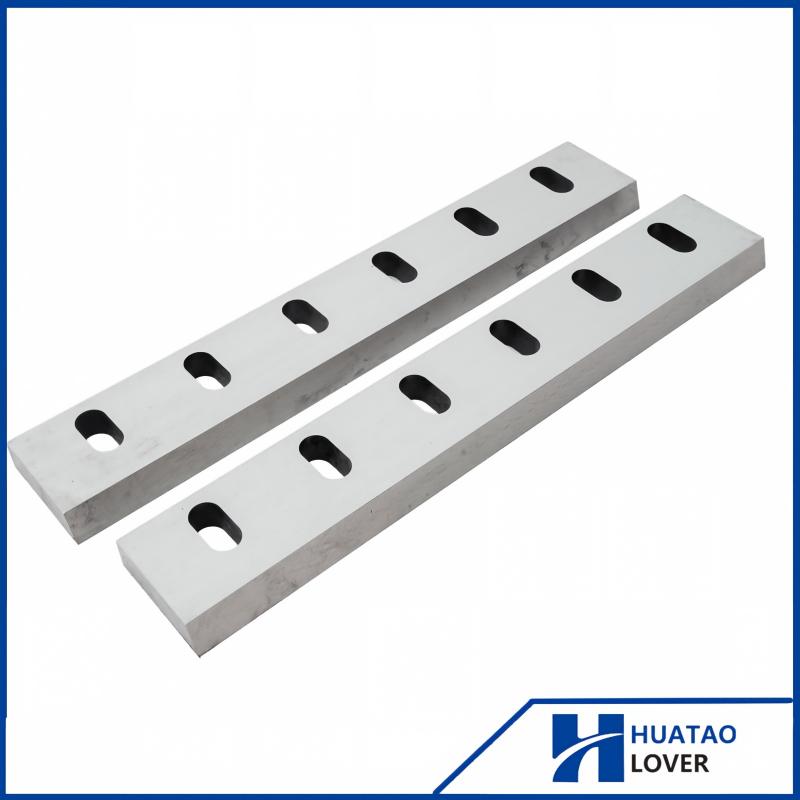
8. Frequently Asked Questions
Q1: Does HRC 60+ guarantee a durable shredder blade?
No. It indicates hardness, but durability also depends on toughness, material, heat treatment, geometry and application.
Q2: Can a blade with HRC 60+ crack?
Yes. Impact conditions and insufficient toughness can contribute to cracking or chipping.
Q3: Is higher hardness always better for abrasive materials?
Not automatically. Material composition, microstructure and operating conditions also affect wear.
Q4: Are SKD11, D2 and DC53 interchangeable?
No. Their characteristics differ, so the choice should be based on the application and required properties.
Q5: Why should buyers ask about heat treatment?
Because heat treatment influences the final material properties and consistency.
Q6: What is the difference between blade wear and blade chipping?
Wear is gradual material loss; chipping is localized breakage of the cutting edge. They may have different causes.
Q7: Can a blade be sharpened instead of replaced?
Sometimes. Remaining thickness, cracks, edge damage and the permitted blade geometry determine whether sharpening is appropriate.
Q8: What should be included in a blade RFQ?
Machine details, drawings, dimensions, feed material, operating hours, current blade information and photos of the failure pattern.
Conclusion
HRC 60+ can be a relevant specification, but it should never be treated as a standalone guarantee of blade durability.
The best purchasing decision considers hardness, toughness, steel grade, heat treatment, cutting geometry and the actual operating environment together. This approach gives engineers and procurement teams a more reliable basis for evaluating blade performance and total operating cost.
Related Articles
Technical Guides
Products and Equipment
Contact
Email: Team5@huataogroup.com
Tel / WeChat / WhatsApp: 008613383116640
WhatsApp: http://wa.me/13383116640
Website: www.huataoshredder.com
#ShredderBlade #BladeHardness #HRC60 #BladeDurability #BladeToughness #IndustrialShredder #ShredderBladeMaterial #ToolSteel #SKD11 #D2Steel #DC53 #HeatTreatment #WearResistance #BladeFailureAnalysis #BladeChipping #BladeCracking #BladeMaintenance #BladeSharpening #RecyclingMachinery #IndustrialEngineering



 WhatsApp