1. What Is an Industrial Plastic Crusher?
An industrial plastic crusher is a size-reduction machine designed to cut plastic waste into smaller flakes or particles.
It is commonly used in plastic recycling facilities, manufacturing plants, and production workshops to process plastic containers, pipes, sheets, film, and other suitable plastic materials.
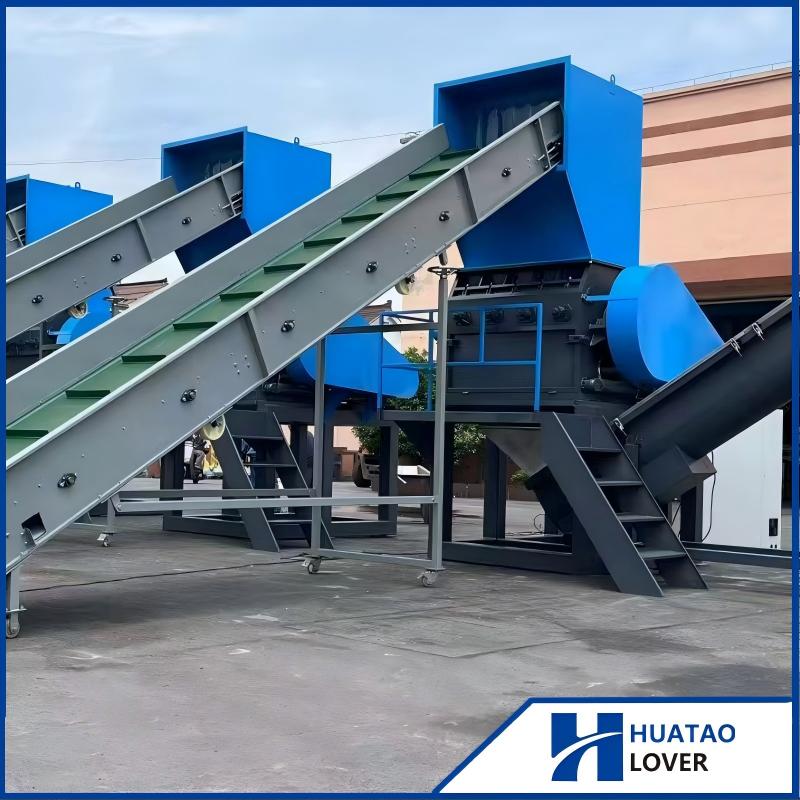
A typical PLASTIC CRUSHER MACHINE consists of a feeding hopper, cutting chamber, rotating rotor, cutting blades, fixed knives, screen, drive system, and discharge arrangement.
The exact structure varies according to the material and application.
2. How Does a Plastic Crusher Work?
The crushing process generally includes four stages.
Stage 1: Feeding
Plastic materials enter the machine through the feeding hopper. Feeding may be manual or integrated with a conveyor system.
Stage 2: Cutting
The rotating blades work against fixed knives to cut the plastic into smaller pieces.
Stage 3: Size Control
The crushed material remains in the cutting chamber until particles can pass through the screen openings.
Stage 4: Discharging
The processed plastic flakes pass through the screen and are collected or transported to the next process.
The rotor design, blade condition, screen aperture, material characteristics, and feeding conditions all influence the final result.
3. What Materials Can a Plastic Crusher Process?
Different plastic materials have different processing characteristics. The machine configuration should reflect these differences.
| Material |
Main Characteristics |
Selection Considerations |
| PET bottles |
Hollow containers |
Feeding and material preparation |
| HDPE containers |
Rigid and relatively thick |
Cutting chamber and blade arrangement |
| PP woven bags |
Flexible and lightweight |
Feeding stability and possible wrapping |
| PE film |
Thin and flexible |
Anti-winding considerations |
| ABS plastic |
Rigid molded products |
Material dimensions and cutting resistance |
| PVC pipes |
Long and tubular |
Feeding opening and pipe dimensions |
| Plastic lumps |
Bulky and irregular |
Pre-size reduction may be required |
For bottles, containers, and plastic frames, a PROFESSIONAL PLASTIC CONTAINER CRUSHER may be relevant.
For flexible PE and PP film, consider the specific feeding and anti-winding design of a SPECIALIZED PLASTIC FILM CRUSHER.
4. Plastic Shredder vs. Plastic Crusher: Which Is Better?
Both machines reduce material size, but their functions are different.
| Comparison |
Plastic Shredder |
Plastic Crusher |
| Main function |
Primary size reduction |
Further size reduction |
| Typical feed |
Bulky or large materials |
Smaller or pre-sized materials |
| Output |
Generally coarser pieces |
Smaller flakes |
| Common structure |
One or two rotating shafts, depending on design |
Rotor and fixed cutting blades |
| Typical application |
Initial processing |
Flake preparation |
A SINGLE-SHAFT SHREDDER FOR PLASTIC RECYCLING may be used when bulky materials require primary reduction.
For demanding or irregular plastic feedstock, a DOUBLE-SHAFT SHREDDER SYSTEM may also be considered.
Some recycling plants use a shredder followed by a crusher. Others only need a crusher. The correct arrangement depends on feedstock dimensions, target output, and the complete process design.
5. Seven Factors to Consider When Selecting a Plastic Crusher
5.1 Material Type and Condition
Identify the material, dimensions, thickness, contamination level, and feeding characteristics.
Do not select equipment based only on the material name. Two types of HDPE waste, for example, may require different configurations if one consists of thin containers and the other consists of thick industrial lumps.
5.2 Required Processing Capacity
Estimate the required throughput in kilograms or tonnes per hour.
Consider:
Actual capacity depends on the feedstock and machine configuration. Ask the supplier to evaluate your material rather than relying only on a catalogue figure.
5.3 Required Output Size
The target particle size should be determined by the next processing stage.
A washing line, for example, may require a particular flake size for conveying and cleaning. A pelletizing line may require additional size reduction or material preparation.
The screen aperture is an important selection factor, but it does not independently determine the entire particle-size distribution.
5.4 Blade Material and Cutting Geometry
Blades are important wear components in a plastic crusher.
Their performance depends on material selection, heat treatment, hardness, toughness, cutting geometry, and operating conditions.
Review the PLASTIC CRUSHER BLADE MATERIAL SELECTION GUIDE before comparing blade options.
Also consider whether replacement blades are readily available and whether they can be sharpened when appropriate.
5.5 Motor Power and Rotor Design
Motor power should be evaluated together with rotor dimensions, cutting chamber structure, blade arrangement, and material resistance.
A larger motor does not automatically mean higher practical throughput.
Ask the supplier to explain how the proposed drive and rotor configuration suit your material.
5.6 Screen and Discharge Configuration
Screen aperture influences which particles can pass through the cutting chamber.
A smaller aperture may require more cutting before particles can pass, which can affect throughput.
Also consider how the crushed material will be discharged and transported to the next stage.
5.7 Maintenance and Safety
Check the accessibility of the cutting chamber, blade replacement procedure, screen cleaning method, safety guards, and emergency-stop arrangement.
The machine should be suitable for routine inspection and maintenance by trained operators.
6. Benefits of Choosing a Suitable Plastic Crusher
A properly matched machine can provide several operational benefits:
-
Consistent Size Reduction: Suitable cutting and screening configurations help prepare plastic for downstream processing.
-
Process Integration: A crusher can be connected to conveyors, washing systems, and other recycling equipment.
-
Maintenance Planning: Replaceable wear components make scheduled inspection and maintenance possible.
-
Material Preparation: Crushing converts suitable plastic waste into smaller pieces for further processing.
-
Flexible Applications: Different machine configurations can serve different plastic feedstocks.
The actual benefits depend on material conditions, equipment design, and plant operation.
7. Industry Application Matrix
| Industry |
Typical Plastic Waste |
Processing Considerations |
| Plastic packaging |
Bottles and containers |
Container feeding and output size |
| Injection molding |
Sprues, runners, rejects |
Material dimensions and production return |
| Pipe manufacturing |
Pipe offcuts |
Pipe diameter and feeding |
| Film recycling |
PE and PP film |
Wrapping and feeding stability |
| Household plastic recycling |
Mixed rigid plastics |
Sorting and material consistency |
| Plastic product manufacturing |
Sheets and profiles |
Cutting chamber and screen selection |
8. Common Problems and Failure Analysis
| Problem |
Possible Cause |
Recommended Solution |
| Low processing capacity |
Unsuitable feedstock or feeding conditions |
Review material preparation and machine configuration |
| Excessive blade wear |
Abrasive contamination or unsuitable blade specification |
Inspect feedstock and blade material |
| Uneven particle size |
Worn blades or unsuitable screen |
Inspect cutting edges and screen condition |
| Material wrapping |
Flexible material and unsuitable feeding arrangement |
Review rotor and feeding design |
| Frequent blockage |
Overfeeding or material accumulation |
Improve feeding consistency and inspect the chamber |
| Abnormal vibration |
Loose components, imbalance, or mechanical wear |
Stop the machine and inspect according to the maintenance procedure |
Do not continue operating a machine with abnormal noise, vibration, or suspected mechanical damage.
9. Plastic Crusher Maintenance Guide
Regular maintenance helps keep the machine in suitable operating condition.
Daily inspection
-
Check for abnormal noise and vibration.
-
Inspect the feeding and discharge areas.
-
Remove accumulated material according to safe procedures.
-
Check safety devices.
Routine inspection
-
Inspect rotating and fixed blades.
-
Check blade fasteners.
-
Examine screen condition.
-
Check bearings and drive components according to the manufacturer's schedule.
Blade maintenance
Cutting edges gradually wear during operation. When sharpening or replacement is required, use the appropriate procedures and specifications.
Read the CRUSHER BLADE MAINTENANCE GUIDE.
For facilities that sharpen blades in-house, INDUSTRIAL KNIFE GRINDING EQUIPMENT may be worth evaluating.
10. Procurement Guide: What Should Buyers Prepare?
Before requesting a quotation, prepare the following information:
-
Plastic material type and photographs.
-
Maximum material dimensions and thickness.
-
Expected processing capacity.
-
Required output size.
-
Operating hours per day.
-
Available voltage and frequency.
-
Feeding and discharge requirements.
-
Existing upstream and downstream equipment.
Ask the supplier to confirm the proposed machine's working dimensions, drive configuration, screen options, blade specifications, and maintenance requirements.
For a broader process perspective, read the WASTE PLASTIC RECYCLING LINE CONFIGURATION GUIDE.
You can also review the TECHNICAL ARCHITECTURE OF A WASTE PLASTIC RECYCLING LINE.
11. Application Case Study Framework
The following is a sample project evaluation framework, not a claim about a completed customer installation.
Application: Rigid plastic container recycling
Feedstock: HDPE containers and plastic frames
Initial evaluation:
-
Confirm container dimensions and wall thickness.
-
Check whether the material requires sorting or pre-cutting.
-
Define the required output size.
-
Estimate the required hourly throughput.
-
Evaluate the crusher and screen configuration.
Proposed process: Sorting → Crushing → Washing → Dewatering → Drying → Further processing, depending on the final product.
A final equipment recommendation should be made after reviewing material samples and confirming the operating requirements.
Conclusion
Choosing the best plastic crusher for your recycling plant requires a complete understanding of your feedstock and production goals.
Material compatibility, capacity, output size, blade design, rotor configuration, screen selection, and maintenance should all be considered before purchasing.
Rather than choosing equipment based only on motor power or price, ask the supplier to evaluate your actual material and confirm the machine configuration.
A well-matched plastic crusher can become a reliable part of a recycling process, helping prepare plastic waste for washing, separation, and further processing.



 WhatsApp