

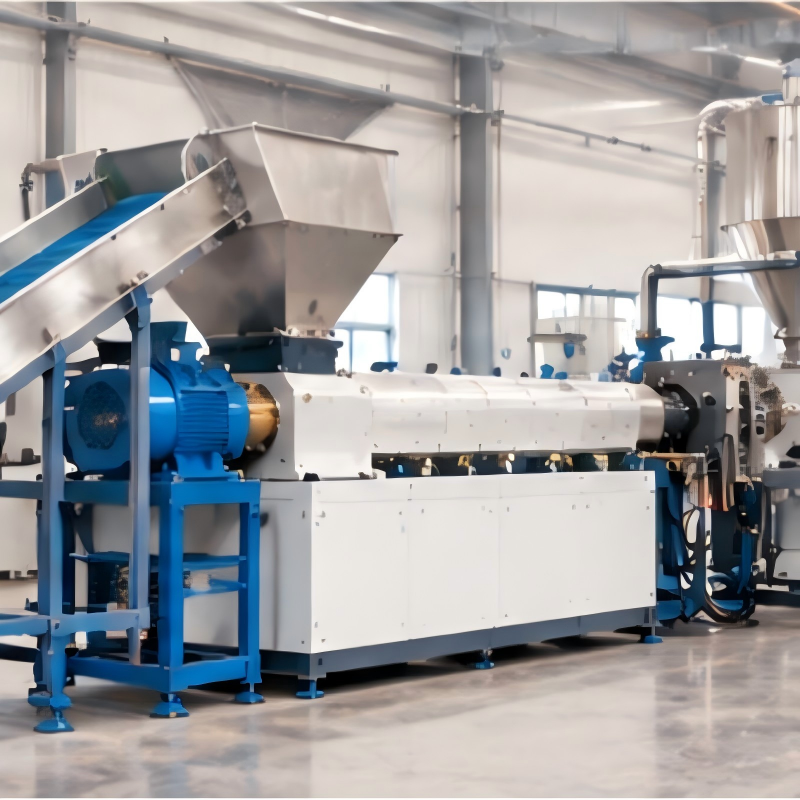
The economic viability of PET recycling operations hinges on the efficiency and reliability of the PET Recycling Pelletizing Machine. As the global rPET market continues to expand—driven by regulatory mandates and brand commitments to recycled content—the economics of pelletizing have become central to investment decisions . A well-specified PET Recycling Pelletizing Machine delivers returns through reduced energy consumption, minimized material waste, and the production of high-value pellets that command premium prices in the plastics market.
Energy Efficiency and Throughput Economics
The PET Recycling Pelletizing Machine represents a significant capital investment, but its operating costs are heavily influenced by energy consumption and throughput capacity. Modern systems incorporate several features that reduce energy intensity per ton of output:
Drive Systems: The main motor of the PET Recycling Pelletizing Machine accounts for the majority of energy consumption. Suppliers are increasingly specifying high-efficiency motors from brands such as Siemens and WEG, combined with frequency converters that adjust speed to match load conditions . This approach can reduce energy consumption by 10-20% compared to fixed-speed alternatives, translating directly to lower production costs.
Process Integration: A well-engineered PET Recycling Pelletizing Machine minimizes the energy wasted through heat losses and inefficient processing. The SAT110 twin-screw extruder, for example, achieves high throughput (1200 kg/h) while maintaining stable process conditions through precise temperature control and optimized screw geometry . Similarly, the KCP series from KITECH emphasizes low energy consumption alongside stable operation, delivering capacities up to 1200 kg/h with modular power ranges of 159-674 kW .
Pelletizing Method Economics: The choice of pelletizing technology—water-ring, underwater, or strand cutting—influences both capital cost and operating economics -10. Underwater pelletizing systems, often specified as complete packages, require higher initial investment but offer advantages in pellet quality and reduced fines generation, which can command premium pricing . Water-ring systems provide a cost-effective alternative for applications where pellet quality requirements are less stringent.
Return on Investment Considerations:
The payback period for a PET Recycling Pelletizing Machine depends on several variables:
Capacity Utilization: The economic model for a PET Recycling Pelletizing Machine assumes high utilization rates, often 24/7 operation in large-scale recycling facilities. Systems with outputs from 200 to 1200 kg/h can achieve payback within 12-24 months when operated at capacity.
Product Quality and Pricing: The price differential between low-grade and high-grade rPET pellets can be significant. A PET Recycling Pelletizing Machine that produces food-grade pellets with controlled IV values commands substantially higher prices than systems producing only downcycled grades . The SSP IV-enhancement capability, while adding capital cost, enables producers to access premium markets.
Contamination Management: The filtration system of the PET Recycling Pelletizing Machine directly impacts operating costs. Larger filtration areas (e.g., 1600 cm²) reduce the frequency of screen changes and associated downtime, contributing to higher overall productivity . Facilities processing heavily contaminated feedstock benefit most from robust filtration specifications, despite higher capital costs.
Contact us:
Marketing@huataogroup.com
Tel:+86 13383116640 (Wechat/whatsapp)
http://wa.me/13383116640
Website:www.huataoshredder.com
#PETRecycling #PelletizingMachine #rPET #RecyclingEconomics #EnergyEfficiency #ROI #PlasticRecycling #Huatao #SustainableManufacturing #CircularEconomy
can not be empty
can not be empty

HUATAO GROUP - Recycling Machine and Spare parts
ADD : No.298 Zhonghua North Street, Shijiazhuang 050000 China.
TEL : +86 13383116640
EMAIL :marketing@huataogroup.com
 WhatsApp & WeChat : +86 13383116640