

The global transition toward a circular plastics economy has placed unprecedented demand on recycling technologies capable of producing high-quality secondary raw materials. At the forefront of this transformation stands the PET Recycling Pelletizing Machine, a sophisticated extrusion system engineered to convert washed PET bottle flakes into uniform, high-purity pellets suitable for demanding manufacturing applications—including food-grade bottle-to-bottle recycling -7-12. Unlike general-purpose plastic extruders, the PET Recycling Pelletizing Machine is specifically designed to address the unique challenges of processing recycled PET: moisture sensitivity, intrinsic viscosity (IV) degradation, and contamination management.
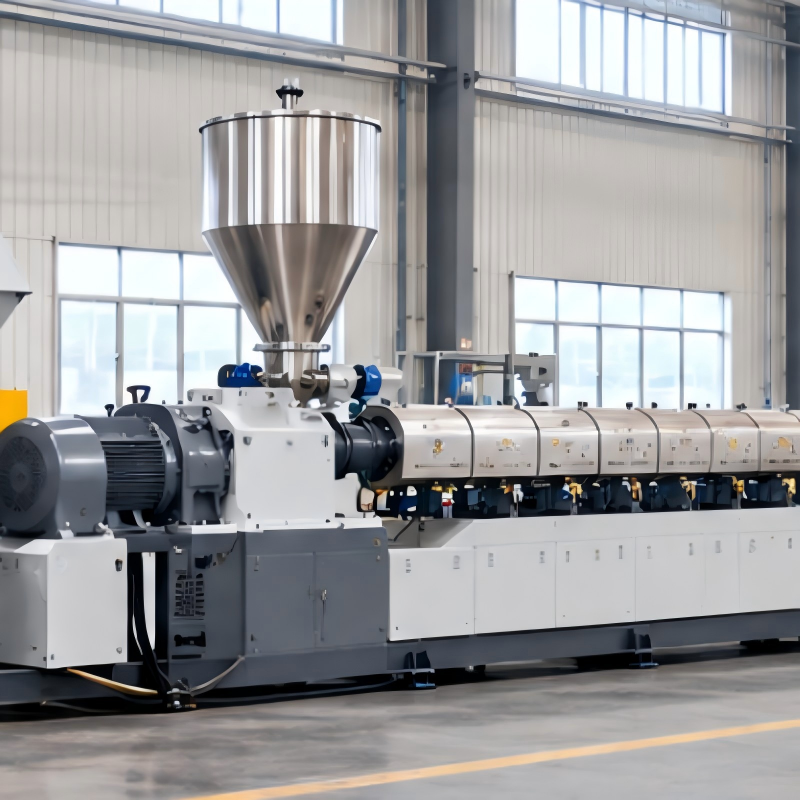
Understanding the PET Recycling Pelletizing Machine Technology
A complete PET Recycling Pelletizing Machine system integrates multiple unit operations that work in concert to produce consistent, high-quality rPET pellets. The typical process flow begins with the controlled feeding of PET flakes into the extruder, followed by melting, degassing, melt filtration, pelletization, and post-treatment -5-6. Each stage must be precisely engineered to prevent the hydrolytic degradation that can reduce the polymer's intrinsic viscosity—a critical parameter that determines the mechanical properties of the final product .
The core of the PET Recycling Pelletizing Machine is the extruder itself. Two primary extruder configurations dominate the market: single-screw and twin-screw systems -4-5. Twin-screw extruders, such as the SAT110 model used in 1200 kg/h lines, offer superior compounding and devolatilization capabilities, making them the preferred choice for challenging PET recycling applications . These systems feature modular screw designs that can be customized to match the specific characteristics of the incoming flake material, optimizing melting efficiency and minimizing thermal degradation .
Critical Process Control in the PET Recycling Pelletizing Machine
IV Management and Degassing: PET is highly sensitive to moisture and temperature. Even trace amounts of moisture (below 50 ppm) can trigger hydrolysis during high-temperature extrusion, causing a significant drop in IV . Advanced PET Recycling Pelletizing Machine systems incorporate dual-stage vacuum degassing—often combining Roots and screw vacuum pumps—to extract moisture and low-molecular-weight volatiles from the melt zone . This degassing capability is essential for maintaining IV values within the 0.72–0.80 dl/g range required for high-end applications like bottle preforms and strapping .
Melt Filtration and Pressure Stability: Incoming PET flakes inevitably contain contaminants—paper labels, aluminum, elastomers, PVC particles, and fines . The PET Recycling Pelletizing Machine addresses this challenge through integrated hydraulic screen changers with large filtration areas (up to 1600 cm²) that remove impurities without creating disruptive pressure spikes. The inclusion of a melt pump downstream of the filter serves to restabilize melt pressure, ensuring consistent strand or pellet quality .
Pelletizing Systems: The PET Recycling Pelletizing Machine supports multiple cutting technologies, including water-ring, underwater, and strand cutting systems . Underwater strand pelletizing, where extruded strands are guided through water before cutting, is increasingly specified for its ability to handle high throughputs (up to 1000 kg/h or more) while producing uniform, dust-free pellets . The post-pelletizing cooling and drying stages are critical for preventing clumping and maintaining pellet quality.
Contact us:
Marketing@huataogroup.com
Tel:+86 13383116640 (Wechat/whatsapp)
http://wa.me/13383116640
Website:www.huataoshredder.com
#PETRecycling #PelletizingMachine #rPET #BottleToBottle #PlasticExtrusion #TwinScrew #CircularEconomy #RecyclingTechnology #Huatao #PETPelletizer
can not be empty
can not be empty

HUATAO GROUP - Recycling Machine and Spare parts
ADD : No.298 Zhonghua North Street, Shijiazhuang 050000 China.
TEL : +86 13383116640
EMAIL :marketing@huataogroup.com
 WhatsApp & WeChat : +86 13383116640