

The global demand for secondary metals is accelerating as industries seek to reduce reliance on primary mining and lower their carbon footprint. Producing metal from recycled scrap consumes between 70% and 95% less energy than extraction from virgin ore, depending on whether the material is steel or aluminum . A well-engineered Metal Recycling Line is the cornerstone of this transition, transforming heterogeneous scrap streams—from end-of-life vehicles and electronic waste to industrial production residues—into high-purity ferrous and non-ferrous fractions ready for reintroduction into the manufacturing supply chain .
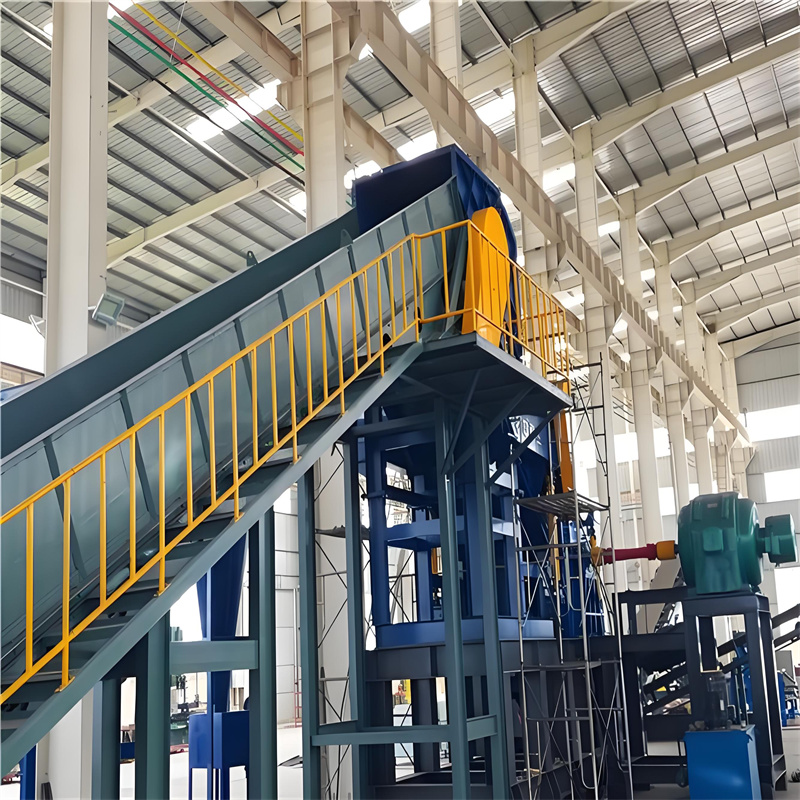
The Technical Architecture of a Metal Recycling Line:
A complete Metal Recycling Line is not a single machine but an integrated system of unit operations designed to progressively liberate, separate, and concentrate metal values. The configuration of a Metal Recycling Line depends on the feedstock—whether processing whole car bodies, shredded appliances, or cable scrap—but the core principles of size reduction, classification, and separation remain consistent.
1. Feed Preparation and Size Reduction
The first stage in any Metal Recycling Line is the reduction of bulky, unwieldy scrap to a manageable particle size. For heavy-duty applications involving whole vehicles or compacted bales, the Metal Recycling Line typically incorporates a pre-shredder to open dense materials and create a homogeneous feed stream -10. This is followed by a primary shredder—often a hammer mill or high-torque shredder—that reduces the material to a consistent size for downstream separation .
Lindemann's EtaRip pre-shredder, for example, is specifically designed to prepare dense and bulky scrap, stabilizing shredder load and extending wear part life . For smaller-scale operations or specific applications like cable recycling, compact hammer mills such as the Compakt 240 offer throughput of up to 150 kg/h, processing heterogeneous materials into fractions suitable for subsequent separation stages. High-capacity hammer mills like the Industry 1300 can achieve up to 12 tons per hour with a 315kW motor, processing mixed ferrous scrap and electric motors.
2. Magnetic Separation: Recovering Ferrous Metals
Following size reduction, the Metal Recycling Line employs magnetic separation to recover ferrous metals—iron and steel—from the shredded stream. This is typically achieved using powerful magnetic drums or overhead magnets that attract and hold ferrous particles, diverting them into a dedicated collection stream .
The importance of early-stage magnetic separation within the Metal Recycling Line cannot be overstated. Removing ferrous metals upstream prevents them from interfering with downstream non-ferrous recovery processes, such as eddy current separation, where magnetic materials can dampen the separation field . According to industry sources, the non-magnetic fraction then proceeds to further processing, where non-ferrous metals like aluminum, copper, and brass are extracted .
3. Non-Ferrous Recovery: The Role of Eddy Current Separation
The recovery of non-ferrous metals is the defining capability of a modern Metal Recycling Line. Eddy current separation technology is the standard solution for this application. When a conductive non-ferrous metal passes over a rapidly spinning rare-earth magnetic rotor, the changing magnetic field induces circulating eddy currents within the metal. By Lenz's Law, these currents generate their own opposing magnetic field, producing a repulsive force that propels the metal particle upward and away from the conveyor belt. Non-conductors—plastics, glass, rubber—fall straight down, completing the separation without any mechanical contact .
Complete Metal Recycling Line systems often integrate eddy current separators capable of processing particles from 5 to 200 mm, with magnetic field strengths of 3,000 gauss and throughput capacities up to 1,000 kg/h -4. As one industry source notes, the combination of robust engineering with advanced magnetic and optical technologies enables the isolation of ferrous and non-ferrous metals from mixed waste streams, ensuring clean, classified material ready for smelting .
Contact us:
Marketing@huataogroup.com
Tel:+86 13383116640 (Wechat/whatsapp)
http://wa.me/13383116640
Website:www.huataoshredder.com
#MetalRecycling #RecyclingLine #ScrapMetal #FerrousMetal #NonFerrousMetal #EddyCurrentSeparator #MetalShredder #WasteManagement #CircularEconomy #Huatao #RecyclingTechnology
can not be empty
can not be empty

HUATAO GROUP - Recycling Machine and Spare parts
ADD : No.298 Zhonghua North Street, Shijiazhuang 050000 China.
TEL : +86 13383116640
EMAIL :marketing@huataogroup.com
 WhatsApp & WeChat : +86 13383116640