

The humble Knife Grinder is undergoing a quiet revolution. While the core purpose—restoring a sharp edge to an industrial blade—remains unchanged, the technology behind these essential maintenance machines is advancing rapidly. Driven by the demands of Industry 4.0 and the need for greater efficiency in recycling and manufacturing, the modern Knife Grinder is now a sophisticated piece of equipment that incorporates automation, precision engineering, and digital connectivity.
The trend is clear: manual, labor-intensive blade sharpening is being replaced by automated, standardized processes. This shift is driven by the need to reduce labor costs, eliminate human error, and achieve consistent, repeatable results that manual sharpening simply cannot provide.
Key Technological Innovations in Knife Grinder Design:
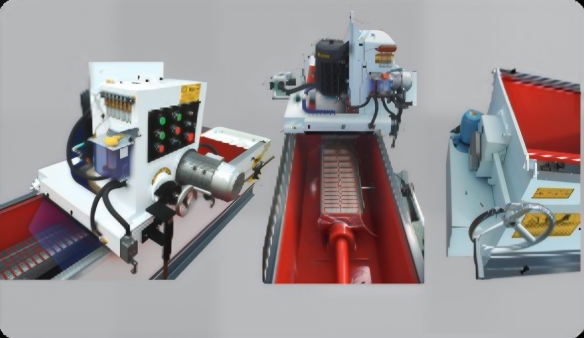
1 PLC Control with HMI Interfaces: The most significant advance is the integration of Programmable Logic Controllers (PLC) with touch-screen Human-Machine Interfaces (HMI). This turns the Knife Grinder into a smart machine. Operators can select pre-programmed sharpening cycles for different blade types, adjust feed rates in increments as small as 0.001 mm, and monitor the entire process in real-time. This level of precision ensures that every blade is sharpened to exact specifications, leading to superior and consistent cutting performance.
2 Smart Monitoring and Remote Support: Some of the most advanced Knife Grinder systems are now being equipped with Wi-Fi connectivity. This allows for remote service support, where technicians can diagnose and even troubleshoot issues without being physically present. This feature can significantly reduce downtime and ensure that the machine is always operating at peak performance.
3 Enhanced Cooling and Safety: The integration of robust coolant systems with features like magnetic coolant separators is another key development. This not only prevents blade annealing during sharpening but also extends the life of the grinding wheel. Safety features, such as emergency stop switches and overload protection, are standard on modern Knife Grinder machines.
4 Improved Construction Materials: The need for micron-level accuracy over the long term has driven innovation in the construction of the Knife Grinder body. Many modern models use double iron plates fortified with double-layer welding to prevent deformation over long operational periods. This rigidity is crucial for maintaining the machine's accuracy and ensuring a consistent, flawless edge.
The Knife Grinder and the Future of the Factory:
The development of HUATAO Knife Grinder is reflective of a broader trend in industrial automation. As factories become more connected and data-driven, maintenance equipment must also evolve. A smart Knife Grinder can be integrated into a plant's overall management system, providing data on blade usage, sharpening frequency, and wear patterns, which can inform predictive maintenance schedules.
By investing in a technologically advanced Knife Grinder, operators are not just purchasing a sharpening machine; they are investing in a smarter, more efficient future. The latest Knife Grinder models offer unmatched precision, lower operating costs, and the connectivity to integrate seamlessly into a modern, automated production line.
Contact us:
Marketing@huataogroup.com
Tel:+86 13383116640 (Wechat/whatsapp)
http://wa.me/13383116640
Website:www.huataoshredder.com
#KnifeGrinder #Industry40 #IndustrialAutomation #RecyclingInnovation #ManufacturingTechnology #PLC #BladeSharpening #Huatao #FutureOfManufacturing #SmartFactory
can not be empty
can not be empty

HUATAO GROUP - Recycling Machine and Spare parts
ADD : No.298 Zhonghua North Street, Shijiazhuang 050000 China.
TEL : +86 13383116640
EMAIL :marketing@huataogroup.com
 WhatsApp & WeChat : +86 13383116640