

Electronic waste recycling presents one of the most demanding challenges for separation technology. The heterogeneous nature of e-waste—combining plastics, ferrous metals, non-ferrous metals, and precious metals in a single stream—requires sophisticated equipment capable of achieving high-purity separations at commercial throughput rates. The E-Waste Eddy Current Separator has evolved to meet these challenges, incorporating advanced engineering features that enable precise recovery of non-ferrous metals from even the most complex electronic scrap streams.
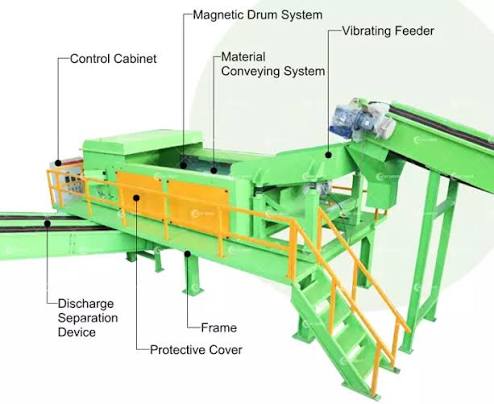
Engineering the E-Waste Eddy Current Separator for Fine Particle Recovery
One of the most significant engineering challenges in e-waste processing is the recovery of fine non-ferrous metal particles. Electronic scrap, after shredding, typically contains metal particles in the 1 to 10 mm size range—substantially smaller than the 50 mm particles that traditional eddy current separators were designed to handle . The E-Waste Eddy Current Separator addresses this challenge through several key engineering innovations:
High-Frequency Rotor Systems: The latest E-Waste Eddy Current Separator designs feature rotors with multiple magnetic poles arranged at high density. High-frequency eccentric rotor configurations, with up to 30 poles, generate rapid field alternations that induce strong eddy currents in fine particles . This design is particularly effective for recovering particles down to 1 mm, ensuring that even the smallest aluminum flakes and copper fragments are captured .
Optimized Rotor Positioning: The E-Waste Eddy Current Separator employs both concentric and eccentric rotor designs, each optimized for specific particle size ranges . Eccentric rotors, which create a concentrated magnetic field at a single discharge point, are particularly effective for processing the fine fractions common in e-waste. In contrast, concentric rotors provide more uniform field distribution for coarser fractions .
Heavy-Duty Conveyor Systems: The E-Waste Eddy Current Separator incorporates robust belt conveyor systems with cantilever frame designs that facilitate quick belt changes and maintenance without disturbing rotor alignment . This feature is essential for maximizing uptime in high-throughput recycling operations.
Recovery Performance in Electronic Scrap Applications:
The effectiveness of the E-Waste Eddy Current Separator in electronic scrap processing is well-documented:
1 PC Scrap Processing: Studies have demonstrated that an E-Waste Eddy Current Separator can achieve aluminum concentrate purity of 85% with recovery exceeding 90% from shredded personal computer scrap . This performance is achieved despite the challenging particle size distribution and the presence of mixed materials typical of electronic waste.
2 Mixed Electronic Scrap: When processing mixtures of PC and printed circuit board scrap, the E-Waste Eddy Current Separator has shown robust performance in recovering both aluminum and copper fractions .
3 Fine Fraction Recovery: Research has confirmed that E-Waste Eddy Current Separators can effectively concentrate non-ferrous metals in the 2 to 6 mm range. This capability is critical for capturing the fine metal particles that constitute a significant portion of the non-ferrous value in electronic scrap.
E-Waste Eddy Current Separator vs. Alternative Separation Technologies:
While several technologies can be applied to non-ferrous metal recovery from e-waste, the E-Waste Eddy Current Separator offers distinct advantages:
1 Technology Best Application Limitation
2 E-Waste Eddy Current Separator Non-ferrous metals 1-50 mm Less effective for <1 mm particles
3 Corona-Electrostatic Separation Fine particles <1 mm Limited throughput
4 Magnetic Separation Ferrous metals only Cannot recover non-ferrous
5 Air Classification Particles with density differences Less selective for similar densities
6 Integrating E-Waste Eddy Current Separator into Complete Recycling Lines
For optimal results, the E-Waste Eddy Current Separator should be integrated into a comprehensive processing flowsheet that includes:
1 Size Reduction: Shredding or crushing to liberate metals from non-metallic components
2 Screening: Particle size classification to optimize feed for the E-Waste Eddy Current Separator
3 Magnetic Separation: Removal of ferrous metals upstream of the E-Waste Eddy Current Separator
4 Eddy Current Separation: Recovery of non-ferrous metals using the E-Waste Eddy Current Separator
5 Density Separation: Further upgrading of recovered metal fractions as needed
Conclusion:
The E-Waste Eddy Current Separator has become an indispensable technology in modern electronic waste recycling. Its ability to recover fine non-ferrous metal particles at high purity and recovery rates makes it the preferred solution for recovering value from the world's fastest-growing waste stream. By incorporating advanced engineering features—including high-frequency rotor designs, rare earth magnet technology, and flexible operating controls—the E-Waste Eddy Current Separator enables recyclers to maximize resource recovery while minimizing environmental impact.
Contact us:
Marketing@huataogroup.com
Tel:+86 13383116640 (Wechat/whatsapp)
http://wa.me/13383116640
Website:www.huataoshredder.com
#EddyCurrentSeparator #EWaste #WEEERecycling #MetalRecovery #NonFerrousRecycling #ElectronicScrap #RecyclingEngineering #Huatao #Sustainability #ResourceRecovery #CircularEconomy
can not be empty
can not be empty

HUATAO GROUP - Recycling Machine and Spare parts
ADD : No.298 Zhonghua North Street, Shijiazhuang 050000 China.
TEL : +86 13383116640
EMAIL :marketing@huataogroup.com
 WhatsApp & WeChat : +86 13383116640