A shredder is a size-reduction device constrained by material behaviour and process requirements. Motor power determines available torque and cutting force, but it does not determine throughput, output quality or total cost of ownership. Selection must begin with the material and the downstream process.
Material Behaviour Under Cutting and Shearing
Plastic film wraps around shafts and requires anti-winding geometry. Rigid HDPE and PVC fracture under high torque with controlled screen output. Steel scrap abrades cutting edges and demands reinforced chambers and wear liners. Tires contain steel wire that damages blades if not debeaded before shredding. E-waste combines brittle, ductile and abrasive components in a single feed stream.
A SINGLE SHAFT SHREDDER uses a rotor, hydraulic pusher and screen to control output size. A DOUBLE SHAFT SHREDDER MACHINE uses two counter-rotating shafts to tear and shear bulky, irregular or mixed feedstock. The 1200 TYPE DOUBLE SHAFT SHREDDER and 800 TYPE DOUBLE SHAFT SHREDDER represent different scale points within the same architecture.
Throughput: A Function of Material, Feed and Configuration
Throughput depends on material bulk density, feed consistency, blade configuration, screen aperture and target output size. A higher-power motor does not guarantee higher capacity. Overfeeding produces jams, not production. Buyers should specify tonnes per hour at a defined material density and output size.
Output Size: Screen Aperture and Secondary Processing
For single shaft machines, screen aperture controls discharged particle size. For double shaft machines, shaft configuration and blade geometry dominate. If finer material is required, secondary crushing or granulation becomes necessary. A CRUSHER MACHINE or PLASTIC GRANULATOR MACHINE may follow primary shredding.
Blade Geometry and Wear Management
Blade material, hardness, thickness and geometry determine cutting performance and wear rate. A CRUSHER BLADE for rigid plastic differs from a SINGLE SHAFT SHREDDER BLADE optimized for film or mixed waste. Customization options include HUATAO WEAR RESISTANT CUSTOMIZATION SHREDDER BLADES matched to specific feedstock.
Maintenance planning should begin before purchase. DO YOU KNOW HOW TO MAINTENANCE AND CARE OF THE SHREDDER BLADE provides practical guidance on blade care that affects service life and operating cost.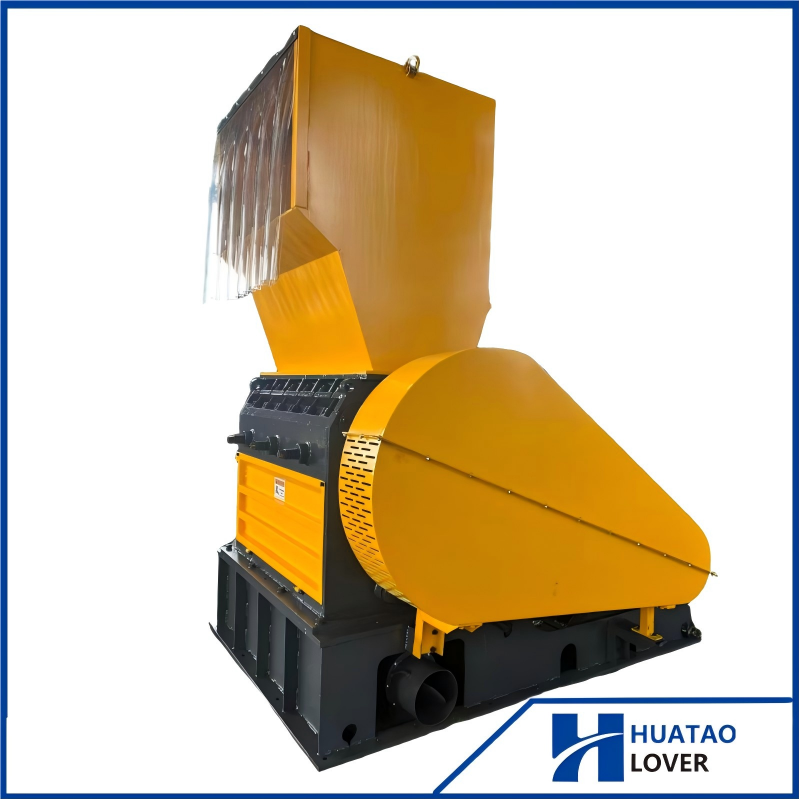
Production Line Integration
A shredder rarely operates alone. A WASTE RECYCLING PRODUCTION LINE integrates feeding, primary shredding, secondary crushing, screening, magnetic separation and further sorting. For plastic recycling, a PLASTIC GRANULATOR MACHINE may follow the shredder. For metal recovery, a SCRAP METAL RECYCLING PRODUCTION LINE combines shredding with magnetic and eddy-current separation. For e-waste, an E WASTE RECYCLING LINE HIGH PURITY ZERO DISCHARGE SYSTEMATIC SOLUTION defines the full recovery chain.
Failure Modes to Design Against
| Failure Mode |
Root Cause |
Design Response |
| Low throughput |
Incorrect feed conditions |
Review feed size and material composition |
| Excessive blade wear |
Abrasive or contaminated feed |
Review blade material and operating conditions |
| Frequent jamming |
Oversized or unsuitable material |
Adjust feeding and anti-jam settings |
| Uneven output |
Worn blades or incorrect screen |
Inspect cutting system and screen |
| Excessive vibration |
Rotor imbalance or bearing issue |
Inspect rotor, bearings and alignment |
| High power consumption |
Overfeeding or mechanical resistance |
Check feed rate and drive system |
| Poor cutting efficiency |
Dull or incorrectly selected blades |
Inspect blade geometry and material |
Related Articles
FAQ
What is the difference between a single shaft and double shaft shredder?
Single shaft shredders use a rotor, hydraulic pusher and screen for controlled output sizing. Double shaft shredders use two counter-rotating shafts for primary shredding of bulky or mixed materials.
How is shredder capacity determined?
Capacity depends on material density, feed conditions, blade configuration, screen aperture and target output size. Motor power alone does not determine throughput.
What information should buyers provide before requesting a quotation?
Material photos or videos, maximum feed dimensions, required capacity in tonnes per hour, target output size, daily operating hours, power supply, factory layout and downstream process details.
How should blade material be selected?
Blade material should match material hardness, abrasion and impact resistance. Different feedstock requires different blade geometries and materials.
Can a shredder be integrated into an existing production line?
Yes, with proper consideration of conveyor systems, downstream equipment, maintenance access and future expansion.
What maintenance does a shredder require?
Daily visual inspection, blade condition checks, abnormal noise and vibration monitoring, lubrication and electrical inspection. Weekly bearing and blade clearance checks. Monthly gearbox, rotor alignment and blade wear measurement.
Contact: marketing@huataogroup.com
008613383116640 (WeChat/WhatsApp)
https://www.huataoshredder.com
#IndustrialShredder #ShredderEngineering #BladeDesign #RecyclingMachinery #WasteManagement #PlasticRecycling #MetalRecycling #ProductionLine #B2BManufacturing #HUATAO



 WhatsApp