A whole tyre is not a material. It is a structure.
Rubber compound, steel bead wire, steel belts, and textile reinforcement are bonded into a single engineered assembly designed to survive tens of thousands of kilometres of road contact. That structure is why tyres are so difficult to recycle. Every recovery route — crumb rubber, tyre-derived fuel, pyrolysis, steel resale — depends on breaking the structure apart first. And the machine that performs this first, most punishing step is the HUATAO Double Shaft Shredder.
What Actually Has to Be Broken ?
Before discussing machines, it is worth being precise about what tyre shredding involves.
A passenger car tyre contains roughly 15% steel by weight. Truck and OTR tyres carry more. That steel is not a single component that can be extracted in one operation. It is distributed through the tyre in two forms: bead wire wound into the sidewall, and steel belts laid beneath the tread.
The rubber itself is vulcanised. Its polymer chains are chemically cross-linked, which is why a tyre does not melt, soften, or flow under heat. It must be mechanically sheared.
And the structure is designed to flex. Rubber deforms under impact rather than fracturing. This single property explains why high-speed shredders and hammer mills struggle with whole tyres: the material absorbs the energy rather than breaking.
The Shear Principle Behind the HUATAO Double Shaft Shredder
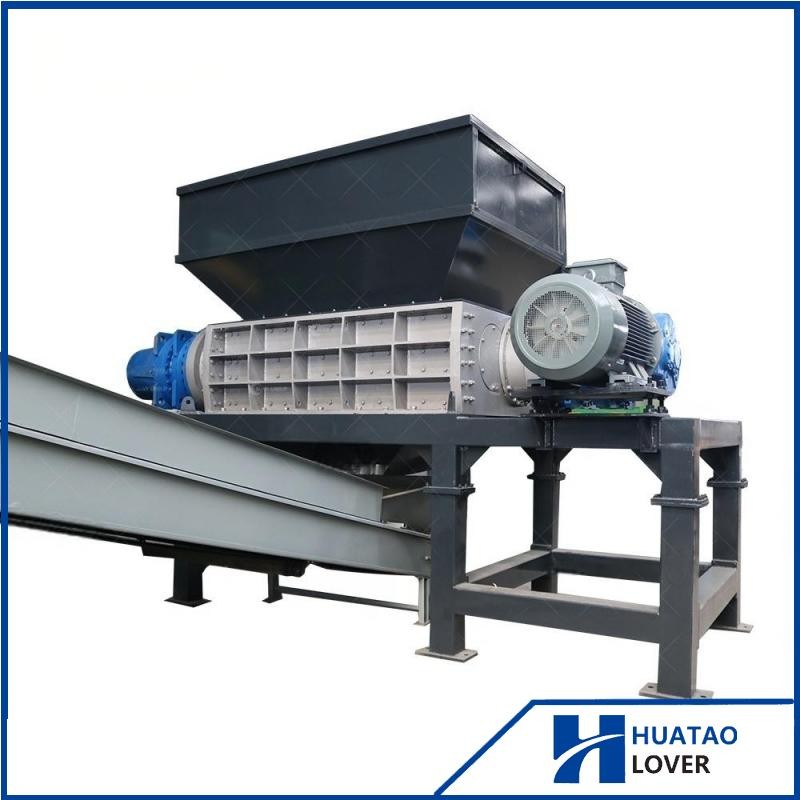
The HUATAO Double Shaft Shredder addresses the tyre's physical character through a different mechanism: sustained shear at low rotational speed.
Two counter-rotating shafts, fitted with hardened cutting blades, grip the tyre and pull it into the cutting chamber. Shaft speeds typically run in the range of 10 to 40 RPM, with torque multiplied through planetary gear reducers. There is no high-speed impact. Instead, the blades apply continuous tearing force until the rubber yields and the steel reinforcement is cut or torn free.
The counter-rotating geometry produces a self-feeding effect. Material is drawn down between the shafts rather than bouncing on top of them. This is the reason the HUATAO Double Shaft Shredder can accept whole tyres — including truck and OTR sizes — that would stall a single-rotor machine.
Chip Quality: The Output That Determines Everything Downstream
The output of the shredding stage is tyre chips, typically 50 to 150 mm in size. These chips are not a final product. They are the feedstock for every subsequent stage in the recycling line.
Chip quality matters more than most operators initially expect. Three characteristics determine downstream performance.
1 Uniformity. A consistent chip size allows the magnetic separator to operate at its design efficiency. Inconsistent chips — some large, some fines — force downstream equipment to compensate for variability it was not designed to handle.
2 Liberation. Chips in which steel remains embedded in rubber reduce both the purity of the recovered steel fraction and the quality of the recovered rubber. The shear action of the HUATAO Double Shaft Shredder cuts and tears the rubber-steel bond rather than simply reducing overall size.
3 Contamination tolerance. Tyres arrive with dirt, water, and occasional foreign objects. The shredder must tolerate these without stalling or damaging blades.
Downstream Routes and Their Requirements
The chips produced by the HUATAO Double Shaft Shredder feed four principal recovery routes, each with its own requirements.
1 Steel recovery. Magnetic separators extract the steel wire. The recovered steel is a saleable commodity for steel mills and foundries. Recovery efficiency depends on the degree of liberation achieved at the shredding stage.
2 Crumb rubber. The rubber fraction is granulated and ground to produce crumb rubber for rubberised asphalt, playground surfaces, sports tracks, and moulded products. Ambient grinding produces rough-surfaced particles that bond well in asphalt; cryogenic grinding produces finer, smoother particles with lower contamination.
3 Tyre-derived fuel. Where material recycling is not feasible, shredded tyre chips serve as tyre-derived fuel with a calorific value of approximately 8,000 kcal/kg. Cement kilns and industrial boilers use TDF as a partial substitute for fossil fuels.
4 Pyrolysis feedstock. Shredded chips also feed pyrolysis reactors, where rubber is broken down into oil, gas, and recovered carbon black. The uniformity of the shredder output affects heat transfer consistency and reaction conditions inside the reactor — making chip quality an economic variable, not just a technical one.
Model Range and Configuration
Huatao manufactures the Double Shaft Shredder in several capacity tiers suited to different tyre processing scales. The 600 Type Double Shaft Shredder serves compact installations. The 800 Type Double Shaft Shredder addresses mid-range operations. The 1000 Type Double Shaft Shredder and 1200 Type Double Shaft Shredder handle higher throughput requirements.
Full specifications are on the Double Shaft Shredder Machine page. Configuration for tyre service includes blade geometry, screen aperture, and drive specification selected according to the tyre size range and target chip size.
The Bead Wire Question
One design decision has a disproportionate effect on HUATAO Double Shaft Shredder performance in tyre service: whether bead wire is removed before shredding.
Bead wire is high-tensile steel wound tightly into the sidewall. When it enters the shredder, it imposes the highest shock loads of any component in the tyre. Removing it beforehand — using a debeading machine — reduces blade wear, lowers energy consumption, and extends the interval between maintenance interventions.
Some operators choose to shred whole tyres without debeading. This is feasible with a robustly specified machine, but the maintenance cost is higher. The decision should be made on the basis of total operating cost, not capital cost alone.
Maintenance in Tyre Service
The HUATAO Double Shaft Shredder operates in a high-wear environment when processing tyres. Steel reinforcement is abrasive, and shock loads from unshreddable inclusions can damage blades and shafts.
A structured maintenance programme is essential. Daily checks cover the cutting chamber, hydraulic system, and screen condition. Weekly and monthly tasks include lubrication, blade inspection, and hydraulic fluid checks. Blade rotation at planned intervals extends service life considerably, and timely sharpening maintains cutting efficiency.
An Industrial Knife Grinding Machine restores blades to specification, and replacement blades are available as Huatao Wear Resistant Customization Shredder Blades. Full maintenance guidance is set out in the Twin Shaft Shredder Maintenance Guide Extend Service Life Cut Operational Cost.
Where the Shredder Sits in a Complete Line?
The HUATAO Double Shaft Shredder is the first stage of a configured tyre recycling line. It is followed by magnetic separation, secondary reduction where finer chip size is required, and granulation or thermal processing depending on the target product.
For complete line configurations, see The Complete Tire Recycling Line Engineering A Sustainable Future For End Of Life Tyres and the Waste Tire Crushing And Grinding Production Line. Where secondary reduction is required, the Single Shaft Shredder range provides controlled output sizing.
For a value-chain perspective on tyre processing, see Huatao Double Shaft Shredders Driving The Circular Economy In Tire Recycling. Broader multi-stream applications are covered in the Waste Recycling Production Line overview.
The Point
A whole tyre resists recycling because of how it is built. The HUATAO Double Shaft Shredder is engineered around that resistance — low speed, high torque, sustained shear, and a counter-rotating geometry that grips rather than bounces.
Its output, the 50–150 mm tyre chip, is the point at which a tyre stops being a disposal problem and becomes a feedstock. Everything downstream depends on getting this stage right.
Contact us:
Marketing@huataogroup.com
Tel:+86 13383116640 (WeChat/WhatsApp)
http://wa.me/13383116640
Website: www.huataoshredder.com
#HUATAO #DoubleShaftShredder #TyreShredding #TireRecycling #WasteTireRecycling #TyreChips #CircularEconomy #WasteManagement #RecyclingEquipment #RubberRecycling



 WhatsApp