

The global challenge of end-of-life tyres (ELTs) represents one of the most pressing waste management issues of our time. With over one billion tyres reaching the end of their service life annually, the need for efficient, scalable recycling solutions has never been greater. The Tyre Recycling Line has emerged as the definitive technology for transforming this waste stream into valuable resources—rubber granules, tyre-derived fuel (TDF), steel wire, and textile fibres—while eliminating the environmental hazards associated with tyre stockpiling and landfilling.
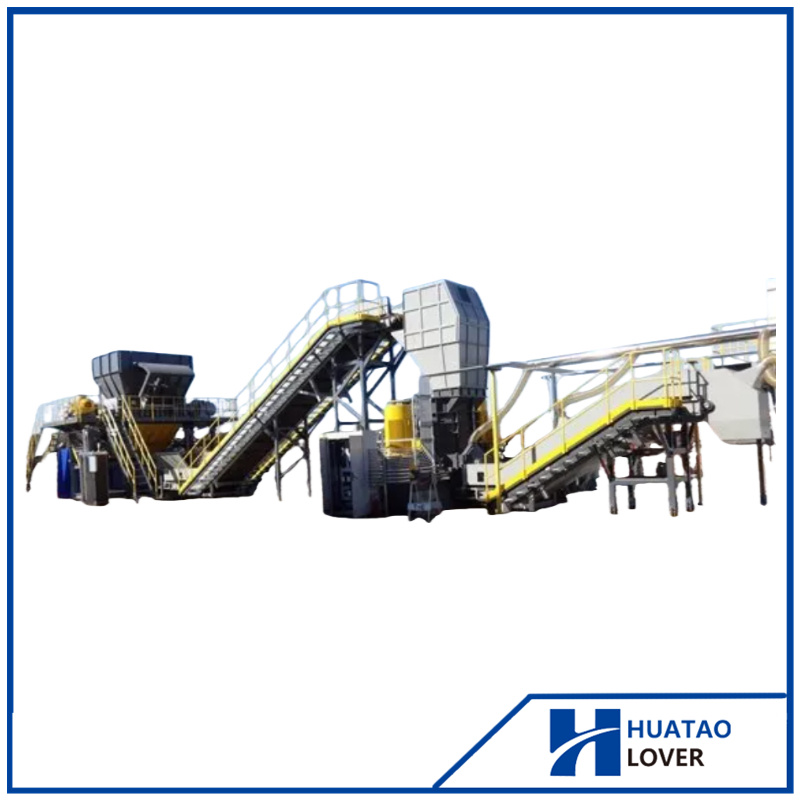
The Technical Architecture of a Complete Tyre Recycling Line:
A modern Tyre Recycling Line is not a single machine but an integrated system of unit operations engineered to progressively liberate, separate, and refine the components of a tyre. Whether processing passenger car tyres, heavy truck tyres, or massive OTR (off-the-road) tyres used in mining and construction, the Tyre Recycling Line follows a systematic sequence of size reduction, steel liberation, granulation, and classification.
Stage 1: Primary Shredding — The Foundation of the Tyre Recycling Line
The first stage in any Tyre Recycling Line is reducing whole tyres to manageable shreds. This is typically accomplished using a high-torque, low-speed dual-shaft shredder that tears tyres into 50–150 mm strips or chips. The Double-Shaft Shredder within the Tyre Recycling Line is engineered with heavy-duty cutting blades capable of handling the steel reinforcement and thick rubber construction of modern tyres.
The primary shredder in a Tyre Recycling Line employs a dual-shaft, low-speed, high-torque design that actively draws material into the cutting chamber, ensuring a continuous, aggressive grip on the rubber. For large-volume operations, the Tyre Recycling Line incorporates infeed conveyor systems that ensure a consistent feed rate, while integrated screening recirculates oversized shreds for reprocessing, achieving uniform shred sizes up to 150 mm . This uniformity is critical for downstream processing efficiency.
Stage 2: Steel Liberation and Separation
The second critical stage of the Tyre Recycling Line is the liberation and removal of steel wire. Tyres contain substantial steel reinforcement—bead wire and steel belts—that must be separated from the rubber fraction to produce high-quality outputs. In a well-configured Tyre Recycling Line, tyre shreds from the primary shredder are introduced to a steel liberator or secondary shredder that processes the material into 20–30 mm steel-free rubber mulch .
The Tyre Recycling Line employs multiple magnetic separation stages to ensure thorough steel removal. An overband magnet positioned over the conveyor extracts liberated steel wire, achieving up to 98% steel-free content in the rubber fraction . The recovered steel wire, with rubber content below 2%, is a valuable byproduct suitable for resale to steel mills and foundries .
Stage 3: Granulation — Refining the Rubber Fraction
Once steel has been removed, the Tyre Recycling Line proceeds to granulation, where the rubber mulch is reduced to uniform granules. The granulator within the Tyre Recycling Line accepts 20–30 mm steel-free crumb rubber and processes it down to 0.8–4 mm rubber granules . At this stage, screens are used to size the material, and air classification systems extract textile fibres that are liberated during the granulation process .
The granulation stage is where the Tyre Recycling Line delivers its greatest value. The rubber granules produced are suitable for a wide range of applications, including:
1 Tyre-Derived Fuel (TDF): Clean, steel-free rubber chips used as alternative fuel in cement kilns and power stations
2 Crumb Rubber: Fine rubber powder for asphalt modification, sports surfaces, and playground tiles
3 Pyrolysis Feedstock: High-purity rubber chips for thermal conversion to oil and carbon black
Stage 4: Fine Grinding and Classification:
For applications requiring finer rubber powder, the Tyre Recycling Line incorporates milling and screening stages. The dual-drive cracker mill accepts 4–8 mm crumb rubber and further processes it into fine powders ranging from 10 to 80 mesh (0.18–1.7 mm) . The Tyre Recycling Line can be configured to produce rubber powder in multiple specifications, from coarse 10-mesh granules for sports surfaces to fine 80-mesh powder for high-value applications .
Applications and Outputs of the Tyre Recycling Line:
The Tyre Recycling Line is designed to maximize value recovery from every tyre processed. The three primary output streams are:
1. Rubber Granules and Powder: The primary product of the Tyre Recycling Line, used in manufacturing new rubber products, modifying asphalt, and producing sports surfaces.
2. Steel Wire: Recovered during the Tyre Recycling Line process, this clean steel is sold to foundries and steel mills as scrap metal.
3. Textile Fibres: Liberated during granulation, these fibres can be separated and used as a fuel source or disposed of responsibly.
Contact us:
Marketing@huataogroup.com
Tel:+86 13383116640 (Wechat/whatsapp)
http://wa.me/13383116640
Website:www.huataoshredder.com
#TyreRecycling #TireRecycling #RecyclingLine #TDF #CrumbRubber #TyreShredder #WasteManagement #CircularEconomy #ScrapTyres #Huatao #RubberRecycling #Sustainability #OTRTyres
can not be empty
can not be empty

HUATAO GROUP - Recycling Machine and Spare parts
ADD : No.298 Zhonghua North Street, Shijiazhuang 050000 China.
TEL : +86 13383116640
EMAIL :marketing@huataogroup.com
 WhatsApp & WeChat : +86 13383116640