Product Overview
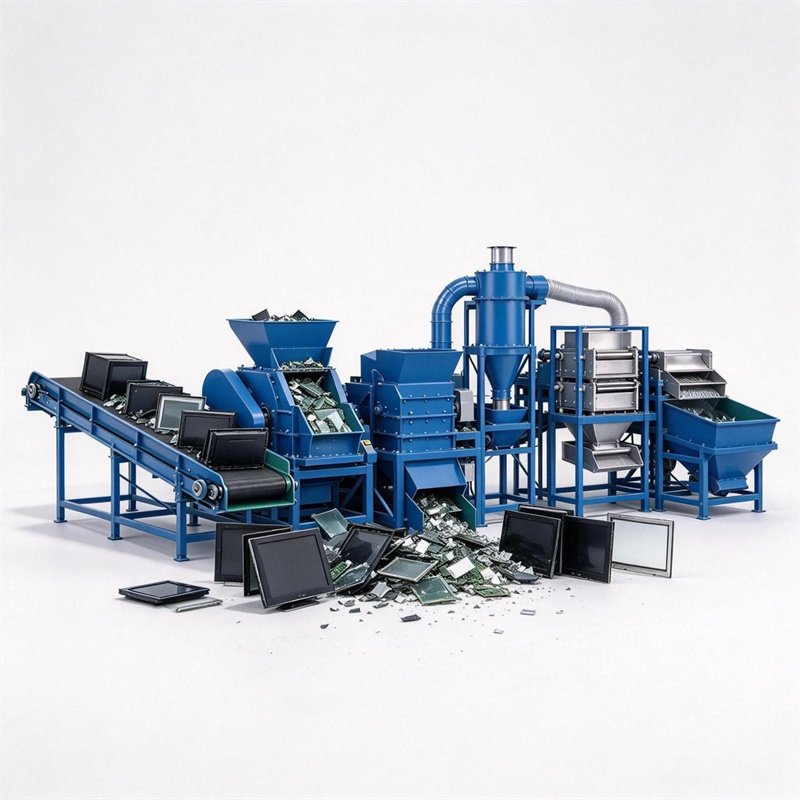
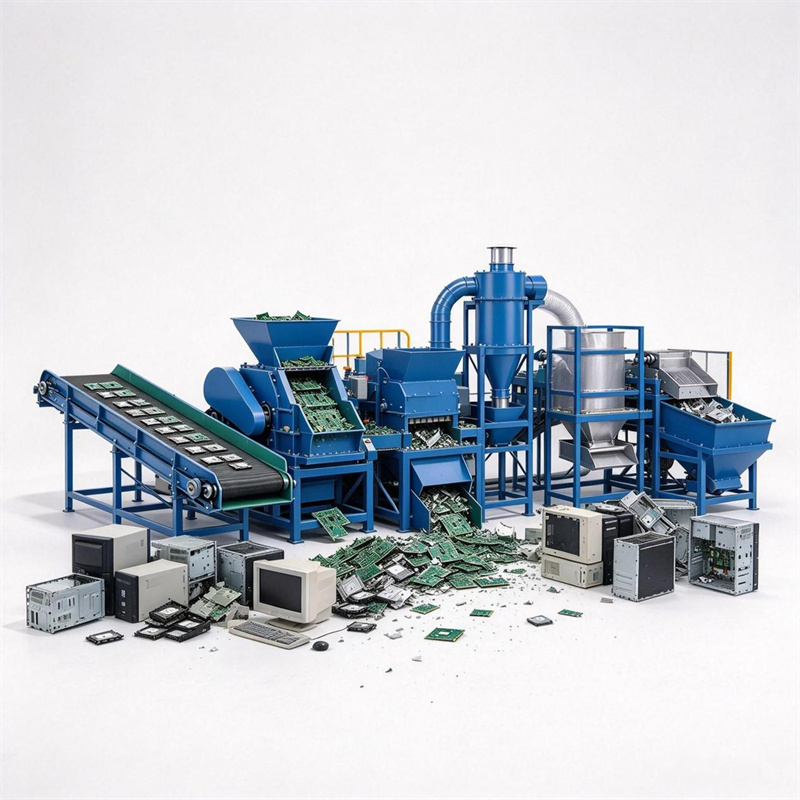
An Electronic Waste Recycling Plant is a complete processing system that transforms end-of-life electronics into separated, saleable material streams. Electronic waste contains substantial quantities of copper, aluminium, steel, and precious metals, along with plastics and hazardous components that require responsible management. The Electronic Waste Recycling Plant integrates size reduction, magnetic separation, eddy current recovery, and dust control into a continuous workflow, recovering valuable materials while meeting environmental compliance requirements.
Huatao designs and manufactures Electronic Waste Recycling Plants for a wide range of feedstock, from whole appliances to circuit boards and mixed electronic scrap. Each plant is configured according to the specific material stream, throughput requirement, and target output specification.
What the Electronic Waste Recycling Plant Processes:
1 The Electronic Waste Recycling Plant handles a broad spectrum of electronic waste:
2 Household Appliances — washing machines, refrigerators, air conditioners, televisions
3 IT Equipment — computers, servers, hard drives, printers, laptops
4 Circuit Boards — motherboards, expansion cards, mobile phone boards, power boards
5 Cables and Wiring — insulated copper and aluminium cable, connector assemblies
6 Mixed Electronic Scrap — collection centre material, WEEE category mixtures
7 Small Domestic Appliances — kettles, irons, toasters, power tools
The plant is configured to accommodate the specific characteristics of each material stream, including the presence of batteries, capacitors, and other hazardous components that require removal or special handling.
Process Stages:
A complete Electronic Waste Recycling Plant follows a defined sequence. Each stage is engineered to liberate, separate, and recover materials progressively.
Stage 1: Hazard Removal and Pre-Processing
Responsible e-waste processing begins with the removal of hazardous components before mechanical reduction. Lithium batteries, mercury-containing lamps, leaded glass, and capacitors must be identified and removed during receiving and pre-processing. This step protects workers, prevents contamination of the material stream, and ensures compliance with environmental regulations.
Manual dismantling may also be performed to recover recover reusable components and prepare equipment for shredding.
Stage 2: Primary Shredding
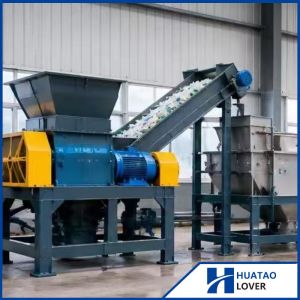
The Double Shaft Shredder performs primary size reduction. Whole appliances, IT equipment, and mixed electronic scrap are fed into the shredder, where counter-rotating shafts with hardened blades tear the material into coarse fragments. The low-speed, high-torque design tolerates the irregular shapes and mixed materials typical of e-waste, including tangled cables and rigid housings.
Huatao manufactures the Double Shaft Shredder in multiple configurations suitable for e-waste applications,
including the 600 Type Double Shaft Shredder,
800 Type Double Shaft Shredder,
1000 Type Double Shaft Shredder,
and 1200 Type Double Shaft Shredder.
Stage 3: Secondary Reduction
Following primary shredding, a Single Shaft Shredder or crusher performs secondary reduction, producing a finer and more uniform particle size suitable for separation. The screen beneath the rotor controls output size, ensuring consistent feed for downstream processes.
Available models include the Single Shaft Shredder HT600 Series, 800 Type, HT 1000 Type, and 1200 Type.
Stage 4: Magnetic Separation
Ferrous metals — iron and steel — are removed using magnetic separation. Overband magnets or magnetic drums extract ferrous particles from the shredded stream, protecting downstream eddy current separators from ferrous contamination and producing a clean steel fraction for sale.
Stage 5: Eddy Current Separation
Non-ferrous metals — aluminium, copper, brass, and zinc — are recovered using Eddy Current Separator technology. The eddy current separator uses a high-speed magnetic rotor to induce eddy currents in conductive particles, generating a repulsive force that ejects non-ferrous metals from the material stream.
Technical background is available in Why Every Modern Recycling Plant Needs A High Performance Eddy Current Separator and Engineering Excellence High Precision E Waste Eddy Current Separators For Demanding Electronic Scrap Processing.
Stage 6: Plastic and Residue Handling
The remaining fraction consists primarily of plastics, glass, and residual fines. Depending on composition and market conditions, this fraction may be further processed to recover specific polymers, used for energy recovery, or disposed of as residual waste. An eddy current separator configured for plastic applications can remove residual metal contamination from this stream.
Stage 7: Dust Collection and Environmental Control
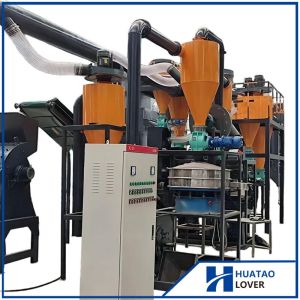
A pulse-jet bag filter dust collection system captures fine particles generated throughout the process. The system operates under negative pressure to prevent dust escape and maintain a clean working environment . This is essential for compliance with WEEE processing standards and for protecting worker health.
Key Features:
Integrated Process Design. The Electronic Waste Recycling Plant combines shredding, magnetic separation, eddy current recovery, and dust control into a coordinated system. Each stage is selected to match the output of the preceding stage, ensuring efficient material flow.
High Recovery Rate. The combination of magnetic and eddy current separation achieves high recovery of ferrous and non-ferrous metals. Material liberation rates of 95% and separation efficiency of 90% are achievable with properly configured systems.
Contamination Tolerance. The Double Shaft Shredder at the primary stage tolerates mixed materials, tangled cables, and irregular assemblies without jamming or excessive downtime .
PLC Control System. Automated control monitors machine performance, provides overload protection, and enables consistent operation with minimal operator intervention.
Dust and Noise Control. Enclosed cutting chambers and negative-pressure dust collection reduce environmental impact and support compliance with WEEE processing standards .
Customizable Configuration. Each Electronic Waste Recycling Plant is configured according to the specific feedstock, throughput requirement, and target output. Hopper sizes, screen apertures, and separation stages are selected to match the application.
Applications
WEEE Recycling Facilities. Processing household appliances, IT equipment, and small domestic appliances into separated metal and plastic fractions.
E-Waste Collection Centres. Volume reduction and initial separation of collected electronic scrap for shipment to downstream processors.
PCB Recycling Operations. Primary shredding of circuit boards for downstream crushing, grinding, and precious metal recovery. See Circuit Board Crushing And Sorting Production Line for dedicated PCB processing.
Metal Recovery Facilities. Integration of e-waste processing into broader metal recycling operations, recovering copper, aluminium, and steel alongside other scrap streams.
Technical Specifications
HT-800 Configuration
Primary shredder chamber 800 mm. Suitable for small to medium throughput. Typical capacity 0.5–1.5 t/h depending on material and configuration.
HT-1000 Configuration
Primary shredder chamber 1,000 mm. Suitable for medium throughput. Typical capacity 1.0–2.5 t/h depending on material and configuration.
HT-1200 Configuration
Primary shredder chamber 1,200 mm. Suitable for higher throughput. Typical capacity 2.0–4.0 t/h depending on material and configuration.
All configurations feature PLC control, magnetic separation, eddy current separation, and dust collection. Voltage is customizable (standard 380V/50Hz). Final specifications are determined by the specific feedstock and output requirements.
Related Equipment
Double Shaft Shredder Machine — primary size reduction
Single Shaft Shredder — secondary size reduction
Eddy Current Separator — non-ferrous metal recovery
Industrial Knife Grinding Machine — blade maintenance
Huatao Wear Resistant Customization Shredder Blades — replacement blades
E-Waste Recycling Line High Purity Zero Discharge Systematic Solution — complete e-waste line






 WhatsApp