Electronic waste is the most metal-dense waste stream in the recycling industry. A single tonne of printed circuit boards contains more copper than several tonnes of copper ore, along with aluminium, brass, and precious metals. But recovering these metals requires a separation technology that can distinguish conductive particles from the complex mixture of plastics, glass, and ceramics that surrounds them. The Eddy Current Separator is that technology — and in e-waste processing, its configuration determines how much of the contained metal value is actually captured.
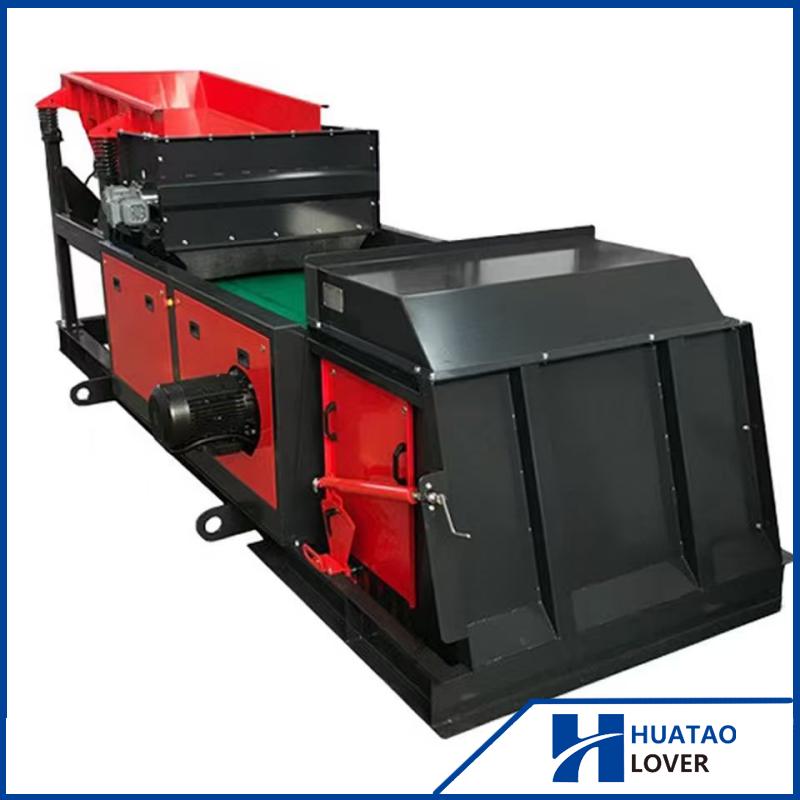
Why E-Waste Requires a Specific ECS Approach?
E-waste differs from other recycling streams in ways that directly affect Eddy Current Separator performance.
The metal particles in shredded electronic scrap are small. After size reduction, copper wire fragments, aluminium shards, and circuit board metallisation are typically measured in millimetres, not centimetres. Conventional eddy current separators designed for municipal solid waste or automotive shredder residue operate effectively on particles of 5 mm and above. E-waste requires finer recovery.
The material is also heterogeneous. A single feed stream may contain steel chassis components, aluminium heat sinks, copper windings, and metallised plastic — all mixed with non-conductive resin, fibreglass, and plastic housings. The Eddy Current Separator must separate conductive from non-conductive particles without being disrupted by the ferrous fraction that remains after magnetic separation.
And the value concentration is high. Copper and aluminium recovered from e-waste command premium prices because of their purity and the growing demand for recycled content in electronics manufacturing. A small improvement in recovery rate translates directly into a significant revenue difference.
How the Eddy Current Separator Recovers Metals from E-Waste?
The Eddy Current Separator operates on the principle of electromagnetic induction. A high-speed rotor fitted with alternating-pole permanent magnets generates a rapidly changing magnetic field at the discharge end of a conveyor belt.
When a conductive non-ferrous particle — copper, aluminium, brass, or zinc — passes through this field, eddy currents are induced within the metal. These currents create a secondary magnetic field that opposes the original field, producing a repulsive force that ejects the metal particle from the material stream . Non-conductive materials such as plastic, glass, and resin are unaffected and follow the natural trajectory of the belt.
The result is a clean separation: metals are thrown forward into a concentrate stream, while non-metals fall away.
The Critical Role of Ferrous Removal
The Eddy Current Separator cannot process ferrous metals. In fact, the attractive forces on iron and steel are stronger than the repulsive Lorentz forces used in eddy current separation. If ferrous material enters the ECS, it will be attracted to the rotor and disrupt the separation process.
This is why magnetic separation must always precede eddy current separation in an e-waste line. Overband magnets or magnetic drums remove ferrous metals after shredding, ensuring that the feed to the Eddy Current Separator is free of iron and steel . In e-waste processing, this sequencing is particularly important because electronic scrap contains significant quantities of steel from chassis, screws, and structural components.
Fine Particle Recovery: The E-Waste Challenge
The defining technical challenge in e-waste Eddy Current Separation is particle size. Shredded circuit boards and electronic components produce metal fragments that are frequently smaller than the effective range of conventional ECS designs.
Recent developments address this limitation. High-frequency eccentric rotor designs, with pole counts and rotational speeds optimised for fine particles, can recover non-ferrous metals down to approximately 1.5 mm in suitable configurations . Multi-pole rotor configurations and optimised magnetic field geometry improve the repulsive force applied to small particles, allowing them to be ejected despite their lower mass.
For e-waste processors, the implication is clear: not every Eddy Current Separator is suitable for electronic scrap. The rotor configuration must be specified for the particle size distribution produced by the upstream shredding stage. A machine optimised for coarse automotive residue will underperform on fine circuit board fragments.
Integration into E-Waste Recycling Lines:
The Eddy Current Separator operates as one stage in a complete e-waste processing line. The typical sequence is:
1 Pre-processing — removal of batteries, capacitors, and hazardous components
2 Primary shredding — reduction of whole devices and assemblies
3 Secondary shredding — finer reduction for liberation
4 Magnetic separation — removal of ferrous metals
5 Eddy current separation — recovery of copper, aluminium, and other non-ferrous metals
6 Further refining — sensor sorting or density separation for higher purity
Each stage prepares the material for the next. The Eddy Current Separator receives feedstock that has already been liberated and freed of ferrous contamination, and it produces a non-ferrous concentrate that can be sold to smelters or refined further.
What to Specify for E-Waste Applications?
When selecting an Eddy Current Separator for e-waste processing, several parameters matter more than they do in other applications:
1 Rotor pole configuration — higher pole counts and eccentric designs suit fine particle recovery
2 Rotor speed — variable frequency control allows adjustment for different particle sizes
3 Belt speed — affects dwell time in the magnetic field and therefore ejection force
4 Splitter positioning — balances recovery rate against concentrate purity
5 Feed preparation — screening before the ECS ensures a controlled particle size distribution
The Eddy Current Separator is not a commodity item. Configuration should be matched to the specific e-waste stream and the target recovery rate.
Conclusion:
E-waste contains some of the highest concentrations of recoverable metals in any recycling stream. The Eddy Current Separator unlocks this value by separating copper, aluminium, and other non-ferrous metals from the complex mixture of non-conductive materials that surrounds them.
For recyclers processing circuit boards, appliances, and mixed electronic scrap, investing in a properly specified Eddy Current Separator — one configured for the fine particle sizes and heterogeneous composition of e-waste — is a direct route to higher metal recovery and improved operational economics.
Contact us:
Marketing@huataogroup.com
Tel:+86 13383116640 (Wechat/whatsapp)
http://wa.me/13383116640
Website:www.huataoshredder.com
#EddyCurrentSeparator #EWasteRecycling #WEEEProcessing #CopperRecovery #AluminiumRecovery #ElectronicScrap #MetalRecovery #Huatao #CircularEconomy #RecyclingEquipment



 WhatsApp