Double Shaft Shredder in the Electronics Industry: The Core Equipment for E-Waste Pre-Processing
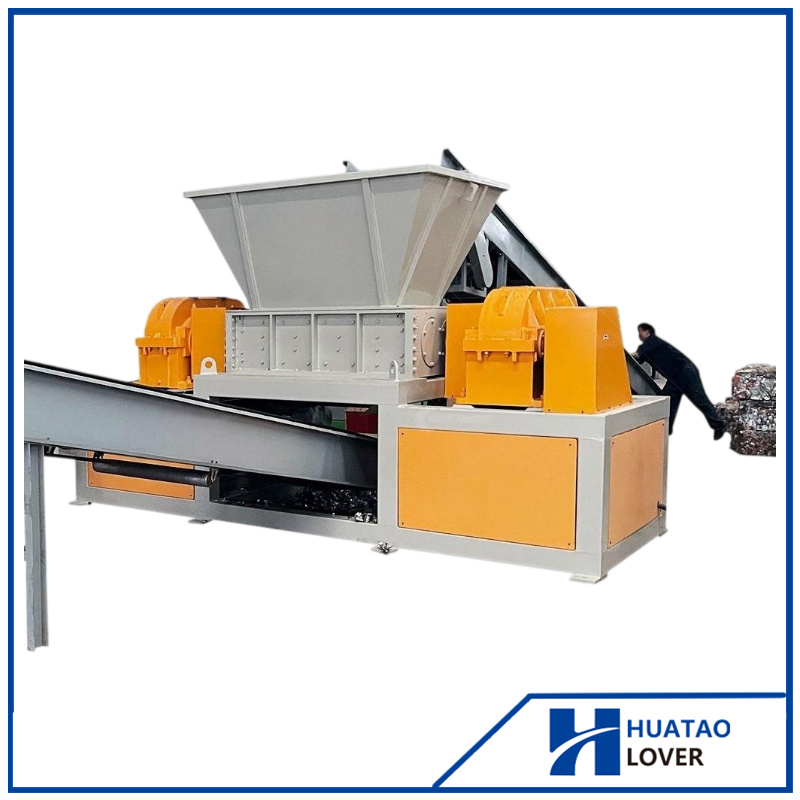
Electronic waste is one of the most complex material streams in the recycling industry. End-of-life televisions, refrigerators, computer towers, circuit boards, and tangled cable bundles arrive in wildly different shapes, hardness levels, and material compositions. A single feed stream may contain steel chassis components, aluminium heat sinks, copper windings, glass display panels, and a dozen different polymer types. Feeding this material directly into fine separation equipment rarely produces acceptable recovery rates — the material is too heterogeneous, too bulky, and too tangled for magnets, eddy current separators, or granulators to handle effectively.
In an e-waste recycling line, the Double Shaft Shredder performs the primary pre-processing role. It reduces complex, heterogeneous electronic scrap into a uniform coarse feedstock that downstream magnetic separation, eddy current separation, and fine metal recovery can actually process. Understanding what this machine does, where it fits, and how to configure it is fundamental to designing an e-waste operation that performs consistently.
The Physics of Liberation: Why Primary Reduction Comes First
Material recovery depends on liberation. A metal cannot be separated from a plastic housing while it remains attached to that housing. An eddy current separator cannot eject a copper fragment that is still embedded in a circuit board substrate. A magnet cannot attract a steel screw that is still seated in a plastic boss. Separation technologies operate on liberated particles. Liberation, therefore, must precede separation.
The Double Shaft Shredder performs this liberation through shear. Two counter-rotating shafts, fitted with hardened cutting blades, grip the material and tear it apart. The forces involved — tension, shear, and compression — are sufficient to break fasteners, fracture brittle components, and delaminate bonded assemblies. What emerges from the Double Shaft Shredder is not a uniform product but a liberated mixture: metal fragments, plastic pieces, circuit board sections, cable segments, and mixed particles. That mixture is precisely what downstream separation equipment requires.
Why Shear Beats Impact in E-Waste Processing?
A reasonable question is why the Double Shaft Shredder — a low-speed, high-torque machine — is preferred over high-speed hammer mills for the primary reduction of electronic scrap. The answer lies in the nature of e-waste as a material.
Electronic scrap is heterogeneous. A single feed stream may contain steel chassis components, aluminium heat sinks, copper windings, glass display panels, and a dozen polymer types. These materials have dramatically different mechanical properties. Impact-based reduction applies a single force profile to all of them, which produces unpredictable results: brittle materials shatter into fines, ductile materials deform rather than break, and mixed assemblies may separate partially or not at all.
Shear-based reduction in the Double Shaft Shredder is more tolerant of this diversity. The counter-rotating shafts apply sustained tearing force until the material yields, regardless of whether that material is brittle, ductile, or composite. The result is a more complete liberation across the full range of materials present in the feed.
Contamination Tolerance: The Practical Advantage:
E-waste arrives with contaminants that would damage or stall other equipment. Appliances contain refrigerant lines, oil residues, and rubber seals. Cable assemblies contain insulation that wraps around rotating components. Some devices contain batteries that must be removed for safety. The Double Shaft Shredder tolerates a degree of contamination that would cause problems for finer reduction equipment. Its low rotational speed and high torque allow it to process materials that would jam a high-speed machine, and its robust construction withstands the shock loads imposed by hard inclusions.
This tolerance is operationally significant. It reduces pre-processing labour, allows a broader range of feedstock to be accepted, and reduces the frequency of unplanned stoppages caused by unshreddable items. Shaft speeds typically range from 10 to 70 RPM, with the gearbox converting high motor speed into low shaft speed — delivering high torque, energy savings, and low dust generation.
PLC Control and Overload Protection:
Modern Double Shaft Shredder installations incorporate PLC control systems with start, stop, reverse, and automatic overload-reverse functions. When hard foreign objects or unusually tough electronic components enter the chamber, the PLC triggers reverse rotation and overload protection, protecting blades and shafts from damage while reducing manual clearing frequency and downtime.
This matters in e-waste processing because the feedstock is unpredictable. A batch of office equipment may contain a sealed compressor that was not removed during pre-processing. A batch of consumer electronics may contain a lithium battery that was missed. The Double Shaft Shredder's protection systems allow it to survive these events without catastrophic damage.
Specific Applications in Electronic Scrap:
The Double Shaft Shredder covers a broad range of materials in the electronics industry. End-of-life appliances — televisions, washing machines, refrigerators, both housings and complete units — are typical processing targets. Printed circuit boards, electronic components, cables, hard drives, and server chassis are also standard inputs. In WEEE recycling, the Double Shaft Shredder is used for primary shredding and coarse grinding of bulky materials and mixed electronic scrap.
Equipment configuration is adjusted for different material types. For precision electronic waste such as circuit boards and chips, blade clearance and rotor speed are optimised to avoid over-crushing and metal loss. For large appliances and server chassis — bulky, hard materials — torque and blade hardness are increased to ensure efficient volume reduction. Blades are manufactured from special alloy steel, with thickness, shape, and arrangement specifically designed for strong shearing force and sharp cutting edges. This configuration flexibility is a key value of the Double Shaft Shredder in electronics applications.
Model Selection for E-Waste Applications:
Huatao manufactures the Double Shaft Shredder in a range of configurations suited to different e-waste processing scales. The 800 Type Double Shaft Shredder suits mid-range operations, while the 1000 Type Double Shaft Shredder and 1200 Type Double Shaft Shredder address higher throughput requirements. A 600 Type Double Shaft Shredder is available for compact installations. Full specifications are on the Double Shaft Shredder Machine page.
Selection is driven by three variables: the maximum feed size the machine must accept, the required throughput in tonnes per hour, and the target output particle size that downstream separation requires.
The Two-Stage Configuration for E-Waste:
E-waste liberation frequently requires two reduction stages. The Double Shaft Shredder performs primary reduction, reducing whole devices and assemblies to a coarse liberated mixture. A Single Shaft Shredder then performs secondary reduction, producing a finer and more uniform particle size suitable for separation.
Available single-shaft models include the Single Shaft Shredder HT600 Series, the Single Shaft Shredder 800 Type, the Single Shaft Shredder HT 1000 Type, and the Single Shaft Shredder 1200 Type.
Two machines, each operating within its design parameters, consistently outperform one machine attempting both functions. The Double Shaft Shredder handles the difficult gripping and tearing work; the Single Shaft Shredder delivers the controlled particle size that separation equipment requires.
Integration with Downstream Processes:
The Double Shaft Shredder is not an isolated machine in an e-waste line. Its output particle size directly affects the efficiency of every subsequent stage. Shredded material typically proceeds to magnetic separation for ferrous removal, then to an Eddy Current Separator for copper and aluminium recovery, and potentially to fine grinding and electrostatic separation for complete metal-resin liberation.
Academic research notes that WEEE processing typically involves dismantling, sorting, and comminution — with comminution intended to effectively liberate metal from non-metal components before physical separation by gravity, magnetic, and electrostatic methods. If primary shredding produces inconsistent output, every downstream separator underperforms.
Technical background on the separation stage is available in Why Every Modern Recycling Plant Needs A High Performance Eddy Current Separator and Revolutionizing E Waste Recycling The Critical Role Of E Waste Eddy Current Separator In Non Ferrous Metal Recovery.
For complete e-waste line configurations, see E Waste Recycling Line High Purity Zero Discharge Systematic Solution and Circuit Board Crushing And Sorting Production Line. The broader Waste Recycling Production Line covers multi-stream applications.
Maintenance: The Deciding Variable:
The Double Shaft Shredder is a high-wear machine in e-waste service. That is inherent to its function — glass, ceramics, and fibreglass-reinforced plastics are abrasive materials.
What distinguishes operations that run reliably from those that struggle is whether maintenance is scheduled or reactive. A detailed Twin Shaft Shredder Maintenance Guide Extend Service Life Cut Operational Cost covers the recommended schedule.
Blade condition is the variable that matters most. Dull blades increase energy consumption, reduce throughput, and accelerate wear on bearings and drive components. We manufacture Huatao Wear Resistant Customization Shredder Blades in application-specific grades, and an Industrial Knife Grinding Machine restores blades to specification.
Supporting guidance includes Did You Know That Crusher Blades Become Dull After Prolonged Use, Tired Of Frequent Blade Changes High Downtime Our Crusher Blades Cut Costs Not Just Materials, and The Most Important Part Of Shredder Shredder Blades. For process verification, equipment testing is documented in Huatao New Shredder Tested Successfully Before Shipment.
Selection Criteria:
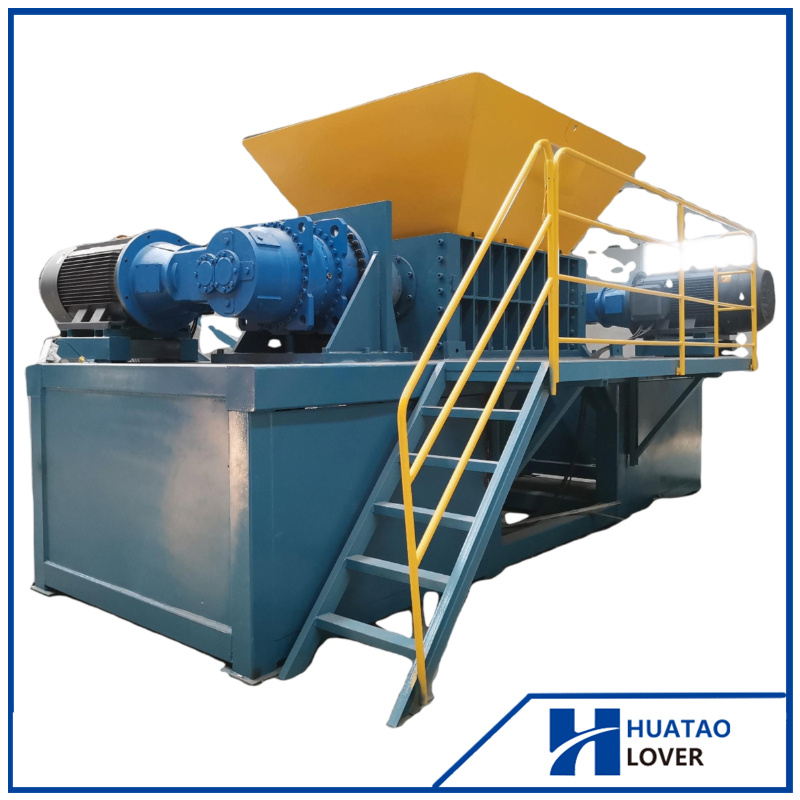
When selecting a Double Shaft Shredder for electronics applications, several parameters demand attention. Throughput capacity (tonnes per hour) must match the overall line capacity. Output particle size must match the feed requirements of downstream separation equipment. Blade material must withstand the metal contaminants commonly present in e-waste. The reliability of the anti-jamming and overload protection system directly determines continuous operation stability. For mixed electronic scrap streams containing multiple material types, equipment adaptability matters more than single-material throughput capability. The high-torque design of the Double Shaft Shredder handles heavy-load scenarios reliably, and its adaptability and anti-jamming capability support continuous, stable operation on complex electronic waste.
The Point:
Electronic waste is difficult material. It is bulky, irregular, contaminated, and assembled in ways that resist simple reduction. The Double Shaft Shredder exists because that difficulty is real — and because every machine downstream depends on it being solved first.
With e-waste resource recovery attracting increasing regulatory attention, the Double Shaft Shredder as the core pre-processing equipment directly influences the metal recovery rate and operating economics of the entire line. For companies planning or upgrading e-waste recycling facilities, optimising the pre-processing stage is often the most direct path to improving overall recovery efficiency.
Contact us:
Marketing@huataogroup.com
Tel:+86 13383116640 (Wechat/whatsapp)
http://wa.me/13383116640
Website:www.huataoshredder.com
#DoubleShaftShredder #EWasteRecycling #ElectronicScrap #WEEERecycling #PrimaryShredding #Huatao #CircularEconomy #WasteManagement #RecyclingEquipment #MetalRecovery



 WhatsApp