Municipal solid waste is not typically described as a metal resource. But it is. Every tonne of MSW contains aluminium cans, copper wire, brass fittings, and other non-ferrous metals that, if recovered, represent both economic value and a reduction in landfill volume. The Eddy Current Separator is the technology that captures this value — and in MSW processing, its role is becoming increasingly important as operators seek to extract more from the waste stream before disposal or energy recovery.
Where Non-Ferrous Metals Hide in MSW?
Non-ferrous metals in municipal waste arrive from multiple sources. Packaging contributes aluminium cans and foil. Electronics contribute copper wiring and circuit board fragments. Construction and demolition debris contributes brass fittings and aluminium profiles. Even household items like pots, pans, and furniture contain recoverable non-ferrous content.
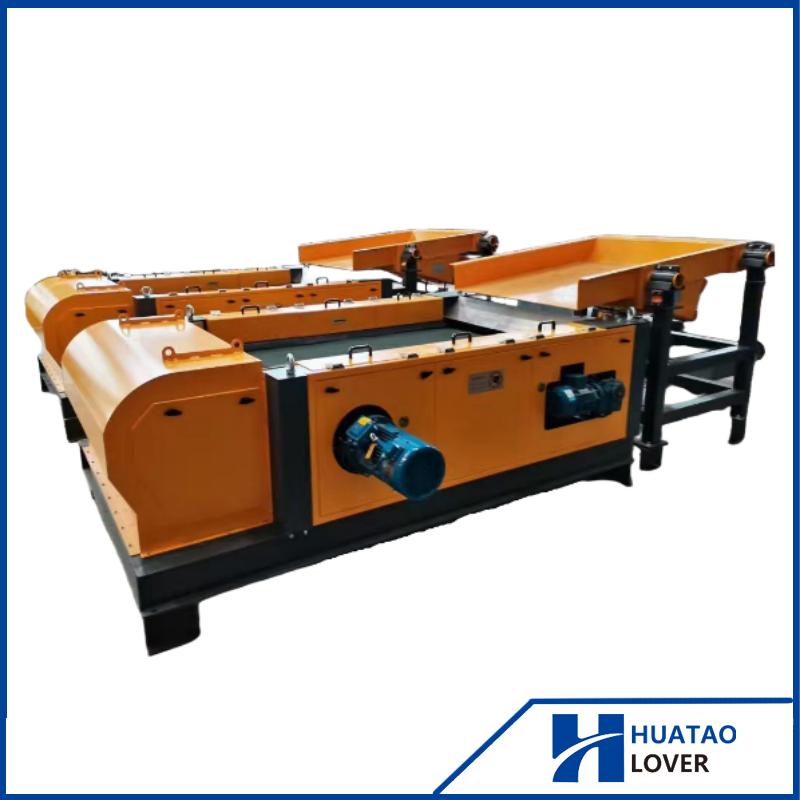
After ferrous metals are removed by magnetic separation, these non-ferrous materials remain mixed with plastics, organics, glass, textiles, and inert residue. The Eddy Current Separator is the machine that separates them — using a high-speed magnetic rotor to induce eddy currents in conductive particles, generating a repulsive force that ejects aluminium, copper, and brass from the material stream.
The Bottom Ash Opportunity
One of the most significant MSW applications for Eddy Current Separation is the processing of incinerator bottom ash (IBA). When municipal waste is incinerated for energy recovery, the residual ash contains concentrated metals that were not combusted. Historically, this ash has been used as construction aggregate or landfilled. But research demonstrates that it contains substantial recoverable value.
A 2025 study published in Recycling developed an extended material recovery sequence for processed IBA, combining magnetic, eddy current, and density separation. The study identified four enhanced product streams: output mineral, high-magnetic, low-magnetic, and non-ferrous fractions. The non-ferrous stream captures copper and aluminium for conventional recycling, while the mineral fraction can be utilized as alternative material for cement clinker and concrete production. The approach moves closer to closing the waste management loop while reducing carbon emissions by providing secondary resources.
Particle Size: The Critical Limitation
The performance of the Eddy Current Separator in MSW applications is strongly dependent on particle size. Industrial ECS units generate field frequencies typically ranging from 500 Hz to 5 kHz, depending on rotor speed and pole configuration. Induced current density is proportional to electrical conductivity, magnetic field variation, and particle geometry.
For small particles, induction efficiency decreases rapidly because of reduced interaction volume and shorter residence time in the magnetic field. This effect becomes critical below approximately 2 to 3 mm, where induced currents are insufficient to produce effective separation. In MSW processing, this means that fine shredder residue requires careful feed preparation — screening before the ECS ensures a controlled particle size distribution and maximizes recovery of the target non-ferrous fraction.
For particles of 2 mm and above, properly configured Eddy Current Separators can achieve sorting efficiencies exceeding 95% for non-ferrous metals.
Integration with Magnetic Separation
The Eddy Current Separator cannot function effectively without upstream ferrous removal. In MSW processing lines, magnetic drums or overband magnets must be positioned before the ECS to remove iron and steel. Without this step, ferrous debris adheres to the high-speed magnetic rotor, disrupting separation and potentially damaging the equipment.
The typical MSW processing sequence therefore follows a defined order: shredding or screening for size control, magnetic separation for ferrous removal, and Eddy Current Separation for non-ferrous recovery. This sequence is not optional — it is the architecture that makes non-ferrous recovery possible.
Economic and Operational Value
The economic case for Eddy Current Separation in MSW processing rests on the value of the recovered metals. Aluminium and copper command significant prices in commodity markets. Recovering them from municipal waste converts a disposal cost into a revenue stream while reducing the volume of material requiring landfill.
The operational case is equally compelling. Modern ECS units are designed for continuous, automated operation, integrating with vibrating feeders and conveyor belts. Recovery efficiency above 95% is achievable for properly sized feed, with minimal manual intervention required.
For MSW processors, the Eddy Current Separator is not a peripheral machine. It is the stage that determines how much non-ferrous value is captured from the waste stream — and how much is lost to residue.
Conclusion:
Municipal solid waste contains recoverable non-ferrous metals. Incinerator bottom ash contains even more. The Eddy Current Separator is the technology that unlocks this value, separating aluminium, copper, and brass from the complex mixture of materials that would otherwise be landfilled or downcycled.
For MSW processing facilities seeking to improve recovery rates and reduce residual waste volumes, investing in properly specified Eddy Current Separation — with attention to particle size preparation and upstream ferrous removal — is a direct route to better operational economics and improved circular economy performance.
Contact us:
Marketing@huataogroup.com
Tel:+86 13383116640 (Wechat/whatsapp)
http://wa.me/13383116640
Website:www.huataoshredder.com
#EddyCurrentSeparator #MSWProcessing #MunicipalSolidWaste #BottomAsh #NonFerrousRecovery #MetalRecycling #Huatao #CircularEconomy #WasteManagement #RecyclingEquipment



 WhatsApp