E-waste is the most valuable waste stream in the recycling industry by unit weight. A tonne of printed circuit boards contains more gold than a tonne of gold ore. A tonne of mixed electronic scrap contains copper, aluminium, steel, and precious metals with a combined market value that dwarfs that of most other recyclable materials.
That value, however, is not automatically realized. It is recovered through a sequence of mechanical and separation processes, and the efficiency of those processes determines how much of the theoretical value is actually captured. The Double Shaft Shredder sits at the beginning of that sequence. Its performance has a disproportionate effect on the economics of the entire operation.
The Liberation-Recovery Relationship
The relationship between liberation and recovery is the fundamental economic principle of e-waste processing. Separation technologies — magnets, eddy current separators, density separators — can only recover materials that have been liberated from one another. A copper wire still attached to a plastic connector will not be recovered as copper. It will be lost in the plastic fraction, or it will contaminate the copper fraction, or it will end up in residual waste.
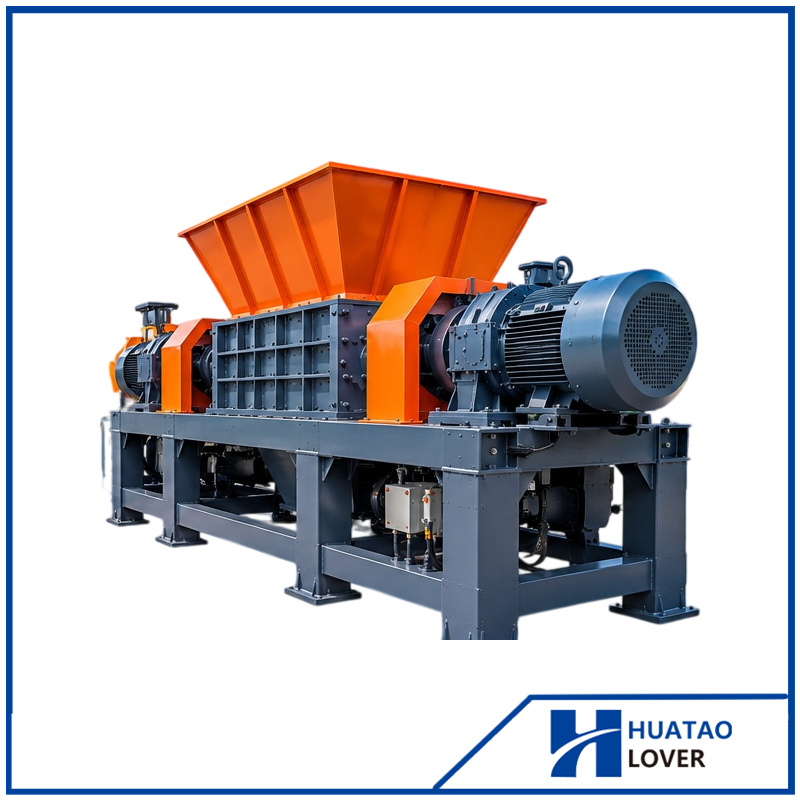
The Double Shaft Shredder determines the degree of liberation achieved in the primary reduction stage. A Double Shaft Shredder that tears material apart completely — breaking fasteners, delaminating bonded assemblies, and fracturing composite components — produces a liberated mixture from which separation equipment can recover a high proportion of the contained metals.
A Double Shaft Shredder that merely breaks material into large pieces produces a partially liberated mixture. Metals remain attached to plastics. Components remain assembled. The separation equipment downstream operates on a compromised feed, and recovery rates fall.
The difference between these two outcomes is significant. In a typical e-waste stream, the difference between 85% and 95% metal recovery represents a substantial revenue difference over the course of a year.
Why Blade Condition Drives Economics
The liberation performance of the Double Shaft Shredder depends on the condition of its blades. Sharp blades shear cleanly through material, breaking mechanical connections and separating components. Dull blades tear and deform material, producing larger fragments with less complete liberation.
This is why blade maintenance is not a maintenance issue but an economic one. A Double Shaft Shredder operating with worn blades does not merely consume more energy and produce a coarser output. It reduces the recovery rate of the entire downstream process. The cost of that reduced recovery typically exceeds the cost of blade sharpening by a substantial margin.
An Industrial Knife Grinding Machine restores blades to specification and maintains liberation performance. Guidance on this is available in Twin Shaft Shredder Maintenance Guide Extend Service Life Cut Operational Cost and Optimizing Shredder Blade Usage A Comprehensive Guide To Efficiency And Longevity.
Throughput and Capacity Economics
The throughput of the Double Shaft Shredder determines the capacity of the e-waste processing line. Capacity, in turn, determines the fixed-cost absorption of the operation. A line processing 500 tonnes per month spreads its capital, labour, and overhead costs across a smaller output than a line processing 1,500 tonnes per month.
This is why Double Shaft Shredder selection must be based on realistic throughput projections, with margin for growth. An undersized Double Shaft Shredder becomes a bottleneck that limits the entire operation. An oversized machine represents unnecessary capital expenditure and may operate below its design efficiency.
Huatao manufactures the Double Shaft Shredder across a range of capacities. The 800 Type Double Shaft Shredder suits mid-range operations, while the 1000 Type Double Shaft Shredder and 1200 Type Double Shaft Shredder address higher throughput requirements. The 600 Type Double Shaft Shredder is available for compact installations. Specifications are on the Double Shaft Shredder Machine page.
The Cost of Contamination
Contamination in e-waste processing reduces the value of recovered fractions. Copper contaminated with aluminium sells at a discount. Aluminium contaminated with plastic may be rejected outright. The Double Shaft Shredder contributes to contamination control by producing a well-liberated feed that downstream separation equipment can process effectively.
A secondary Single Shaft Shredder further refines the material, producing the uniform particle size that optimizes separation efficiency. Available models include the HT600 series, the 800 type, the HT 1000 type, and the 1200 type.
Separation Efficiency and Output Value
The Eddy Current Separator is the stage that actually recovers non-ferrous value from the e-waste stream. Its efficiency depends on the quality of the feed it receives. A well-liberated, uniformly sized feed allows the eddy current separator to achieve high recovery rates with low contamination.
Technical background on this stage is available in Engineering Excellence High Precision E Waste Eddy Current Separators For Demanding Electronic Scrap Processing and Revolutionizing E Waste Recycling The Critical Role Of E Waste Eddy Current Separator In Non Ferrous Metal Recovery.
Complete line configurations are described in E Waste Recycling Line High Purity Zero Discharge Systematic Solution.
Contact us:
Marketing@huataogroup.com
Tel:+86 13383116640 (Wechat/whatsapp)
http://wa.me/13383116640
Website:www.huataoshredder.com
#EWasteEconomics #DoubleShaftShredder #EWasteRecycling #MetalRecovery #WEEERecycling #RecyclingROI #Huatao #CircularEconomy #ElectronicScrap #WasteManagement



 WhatsApp