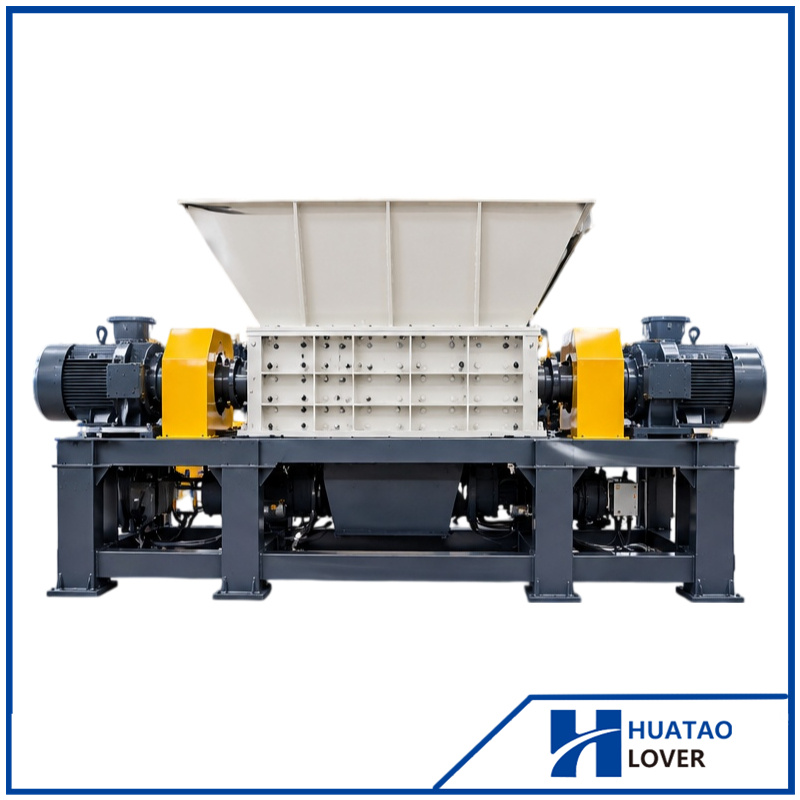
Electronic waste is not a waste stream in the conventional sense. It is an assembled product at the end of its service life — a deliberate construction of metals, polymers, ceramics, and glass, joined by fasteners, adhesives, and mechanical interlocks. The copper inside a hard drive did not arrive there by accident. It was engineered into position to perform a function. Recovering it requires reversing that engineering. And the first step in that reversal is not chemical, not thermal, and not manual. It is mechanical liberation — the physical separation of materials that were deliberately joined. That is the function of the Double Shaft Shredder in an e-waste recycling line.
The Physics of Liberation
Material recovery depends on liberation. A metal cannot be separated from a plastic housing while it remains attached to that housing. An eddy current separator cannot eject a copper fragment that is still embedded in a circuit board substrate. A magnet cannot attract a steel screw that is still seated in a plastic boss. Separation technologies operate on liberated particles. Liberation, therefore, must precede separation.
The Double Shaft Shredder performs this liberation through shear. Two counter-rotating shafts, fitted with hardened cutting blades, grip the material and tear it apart. The forces involved — tension, shear, and compression — are sufficient to break fasteners, fracture brittle components, and delaminate bonded assemblies. What emerges from the Double Shaft Shredder is not a uniform product but a liberated mixture: metal fragments, plastic pieces, circuit board sections, cable segments, and mixed particles. That mixture is precisely what downstream separation equipment requires.
Why Shear Beats Impact in E-Waste Processing
A reasonable question is why the Double Shaft Shredder — a low-speed, high-torque machine — is preferred over high-speed hammer mills for the primary reduction of electronic scrap. The answer lies in the nature of e-waste as a material.
Electronic scrap is heterogeneous. A single feed stream may contain steel chassis components, aluminium heat sinks, copper windings, glass display panels, and a dozen polymer types. These materials have dramatically different mechanical properties. Impact-based reduction applies a single force profile to all of them, which produces unpredictable results: brittle materials shatter into fines, ductile materials deform rather than break, and mixed assemblies may separate partially or not at all.
Shear-based reduction in the Double Shaft Shredder is more tolerant of this diversity. The counter-rotating shafts apply sustained tearing force until the material yields, regardless of whether that material is brittle, ductile, or composite. The result is a more complete liberation across the full range of materials present in the feed.
Contamination Tolerance: The Practical Advantage
E-waste arrives with contaminants that would damage or stall other equipment. Appliances contain refrigerant lines, oil residues, and rubber seals. Cable assemblies contain insulation that wraps around rotating components. Some devices contain batteries that must be removed for safety. The Double Shaft Shredder tolerates a degree of contamination that would cause problems for finer reduction equipment. Its low rotational speed and high torque allow it to process materials that would jam a high-speed machine, and its robust construction withstands the shock loads imposed by hard inclusions.
This tolerance is operationally significant. It reduces pre-processing labour, allows a broader range of feedstock to be accepted, and reduces the frequency of unplanned stoppages caused by unshreddable items.
Model Selection for E-Waste Applications
Huatao manufactures the Double Shaft Shredder in a range of configurations suited to different e-waste processing scales. The 800 Type Double Shaft Shredder suits mid-range operations, while the 1000 Type Double Shaft Shredder and 1200 Type Double Shaft Shredder address higher throughput requirements. A 600 Type Double Shaft Shredder is available for compact installations. Full specifications are on the Double Shaft Shredder Machine page.
The Two-Stage Configuration for E-Waste
E-waste liberation frequently requires two reduction stages. The Double Shaft Shredder performs primary reduction, reducing whole devices and assemblies to a coarse liberated mixture. A Single Shaft Shredder then performs secondary reduction, producing a finer and more uniform particle size suitable for separation. Available models include the HT600 series, the 800 type, the HT 1000 type, and the 1200 type.
Integration with Downstream Separation
The liberated output of the Double Shaft Shredder feeds directly into the separation stages of the e-waste recycling line. Magnetic separation removes ferrous metals. An Eddy Current Separator recovers non-ferrous metals including aluminium and copper. Technical background on this stage is available in Revolutionizing E Waste Recycling The Critical Role Of E Waste Eddy Current Separator In Non Ferrous Metal Recovery and Engineering Excellence High Precision E Waste Eddy Current Separators For Demanding Electronic Scrap Processing.
For complete e-waste line configurations, see E Waste Recycling Line High Purity Zero Discharge Systematic Solution and Circuit Board Crushing And Sorting Production Line.
Maintenance Considerations
The Double Shaft Shredder in e-waste service experiences wear from abrasive materials including glass, ceramics, and fibreglass-reinforced plastics. Blade condition determines performance, and a structured sharpening programme is essential. Guidance is available in Twin Shaft Shredder Maintenance Guide Extend Service Life Cut Operational Cost. Replacement blades are available as Huatao Wear Resistant Customization Shredder Blades.
Contact us:
Marketing@huataogroup.com
Tel:+86 13383116640 (Wechat/whatsapp)
http://wa.me/13383116640
Website:www.huataoshredder.com
#DoubleShaftShredder #EWasteRecycling #ElectronicScrap #WEEERecycling #PrimarySizeReduction #Huatao #CircularEconomy #MetalRecovery #RecyclingEquipment #WasteManagement



 WhatsApp