E-waste recycling is often described in general terms: collect, shred, separate, recover. That description is accurate but uninformative. The actual process is a sequence of specific unit operations, each performing a defined function, each dependent on the performance of the stage before it. This article walks through the e-waste shredding process stage by stage, explaining what happens at each step and why.
Stage One: Receiving and Pre-Processing
E-waste arrives at a processing facility in various forms: whole devices, partially dismantled equipment, components removed during refurbishment, and mixed electronic scrap. The first operational step is not shredding but assessment. Hazardous components — batteries, capacitors, mercury-containing lamps, and refrigerant-containing components — must be identified and removed before shredding. This is a safety requirement and, in many jurisdictions, a regulatory one.
Pre-processing also includes the removal of items that would damage the Double Shaft Shredder or compromise downstream processes. Large electric motors, sealed compressors, and heavy transformers may be routed to separate processing streams. The objective is not to sort the material but to make it safe and suitable for mechanical reduction.
Stage Two: Primary Reduction in the Double Shaft Shredder
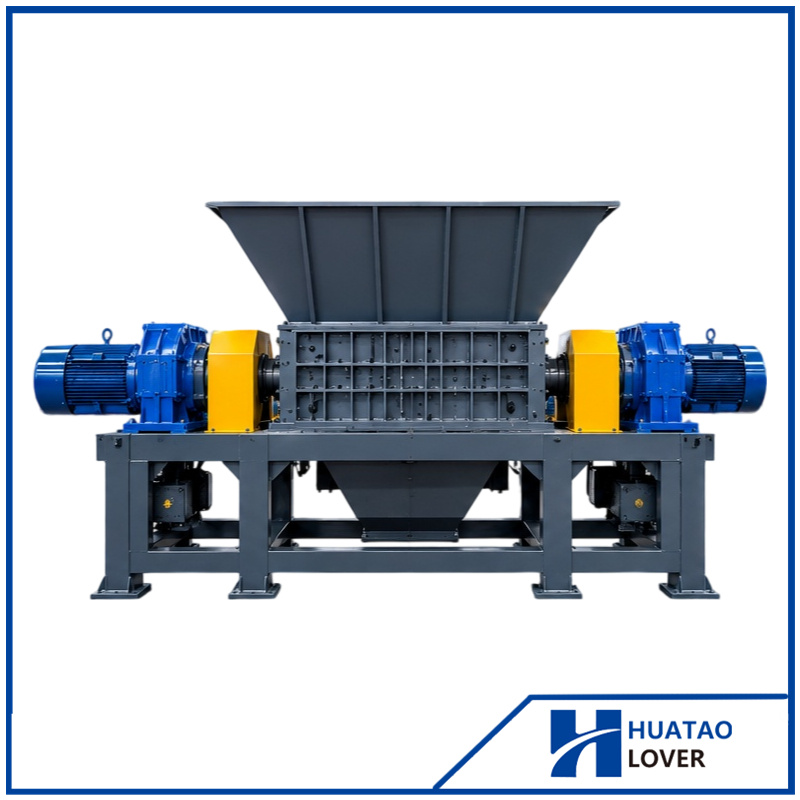
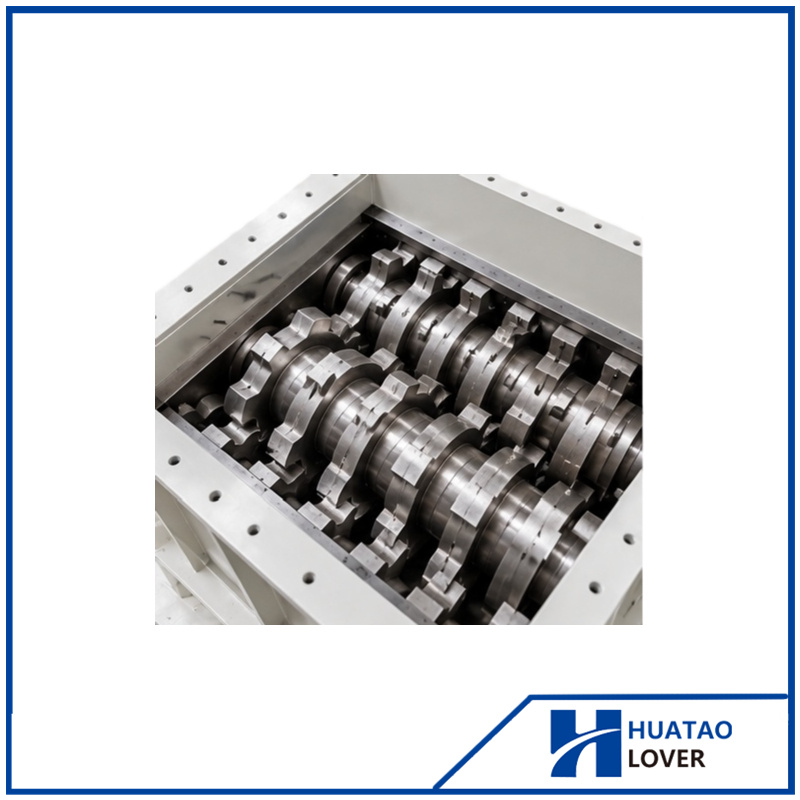
The Double Shaft Shredder performs primary reduction. Whole devices, assemblies, and components are fed into the shredder, where counter-rotating shafts with hardened blades tear them apart.
The Double Shaft Shredder reduces material to a coarse liberated mixture, typically in the range of 50 to 150 mm. The objective at this stage is liberation, not fine sizing. The Double Shaft Shredder must break the mechanical connections between materials — fasteners, welds, adhesives, and interlocks — so that downstream separation equipment can distinguish and separate individual material types.
Huatao manufactures the Double Shaft Shredder in several capacity tiers. The 600 Type Double Shaft Shredder, 800 Type Double Shaft Shredder, 1000 Type Double Shaft Shredder, and 1200 Type Double Shaft Shredder are available to suit different throughput requirements. Specifications are on the Double Shaft Shredder Machine page.
Stage Three: Secondary Reduction
The liberated mixture from the Double Shaft Shredder is typically too coarse for effective separation. A secondary reduction stage produces the finer, more uniform particle size that separation equipment requires.
A Single Shaft Shredder performs this function, applying controlled shearing against a fixed counter knife with a hydraulic pusher. The screen installed beneath the rotor determines the output particle size. Models suitable for this stage include the HT600 series, the 800 type, the HT 1000 type, and the 1200 type.
Stage Four: Ferrous Removal
The first separation stage in the e-waste line is magnetic. An overband magnet or magnetic drum extracts ferrous metals — steel and iron — from the shredded stream. This stage protects downstream equipment, particularly eddy current separators, from ferrous contamination that would disrupt their operation.
The ferrous fraction recovered at this stage is typically sold to steel mills as shredder feed.
Stage Five: Non-Ferrous Recovery
Non-ferrous metals — aluminium, copper, brass, and zinc — are recovered using Eddy Current Separator technology. The eddy current separator uses a high-speed magnetic rotor to induce eddy currents in conductive particles, generating a repulsive force that ejects non-ferrous metals from the material stream.
Eddy current separation is the stage that determines the value of the non-ferrous output from an e-waste line. Its effectiveness depends on the particle size and liberation quality achieved by the preceding shredding stages. Technical background is available in Why Every Modern Recycling Plant Needs A High Performance Eddy Current Separator and Revolutionizing E Waste Recycling The Critical Role Of E Waste Eddy Current Separator In Non Ferrous Metal Recovery.
Stage Six: Plastic and Residue Handling
The remaining fraction after metal recovery consists primarily of plastics, glass, ceramics, and residual fines. Depending on the composition and market conditions, this fraction may be further processed to recover specific polymers, used as fuel in energy recovery applications, or disposed of as residual waste.
An Eddy Current Separator configured for plastic applications can remove residual non-ferrous contamination from this stream. See Efficient Plastic Non Ferrous Metal Sorting For Waste Recycling Lines and Automatic Plastic And Non Ferrous Metal Sorting For Recycling Factories.
Complete Line Configuration
The stages described above are assembled into a complete e-waste processing line. Huatao configures E Waste Recycling Line High Purity Zero Discharge Systematic Solution systems around the Double Shaft Shredder as the primary reduction stage. For circuit board specific processing, see Circuit Board Crushing And Sorting Production Line. General configurations are described in Waste Recycling Production Line.
Contact us:
Marketing@huataogroup.com
Tel:+86 13383116640 (Wechat/whatsapp)
http://wa.me/13383116640
Website:www.huataoshredder.com
#EWasteShredding #DoubleShaftShredder #ElectronicScrap #WEEERecycling #EddyCurrentSeparator #MetalRecovery #Huatao #CircularEconomy #RecyclingProcess #WasteManagement



 WhatsApp