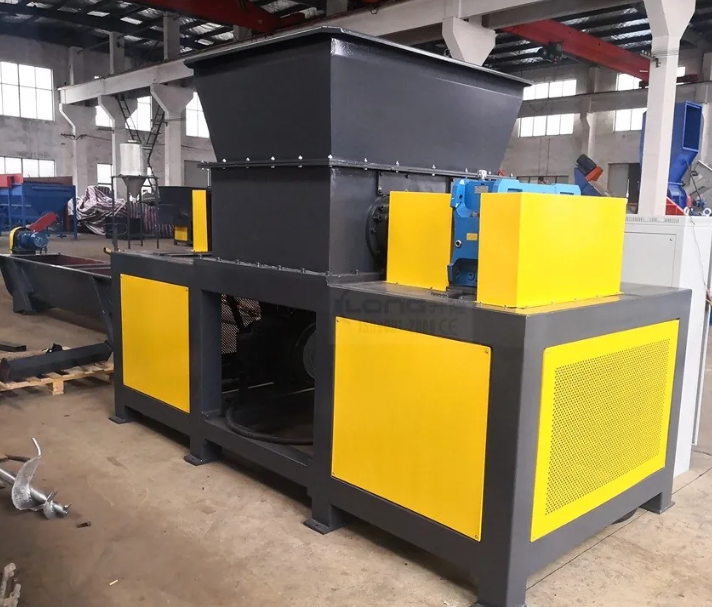
Plastic recycling is not a single process. It is a sequence of processes, each with its own requirements, and each dependent on the stage before it. The Single Shaft Shredder occupies a specific position in that sequence: the secondary reduction stage, where the objective shifts from bulk reduction to controlled particle size. Understanding why this stage exists, and what it contributes, is essential for anyone designing or operating a plastic recycling line.
The Distinction Between Primary and Secondary Reduction
The distinction between primary and secondary reduction is not arbitrary. It reflects a genuine difference in function.
Primary reduction exists to reduce bulk. Its objective is to take large, unwieldy material — bales, purgings, large molded parts, complete containers — and reduce it to a form that can be handled by subsequent equipment. The Double Shaft Shredder performs this function, using counter-rotating shafts to grip and tear material regardless of its shape or density.
Secondary reduction exists to control particle size. Its objective is to take the coarse output of primary reduction and reduce it to a consistent, specified particle size suitable for washing, separation, and granulation. The Single Shaft Shredder performs this function.
This distinction matters because the two functions have different requirements. A machine optimised for bulk reduction prioritises gripping force and throughput. A machine optimised for particle size control prioritises screen configuration and consistent cutting geometry. Attempting to perform both functions with a single machine produces compromises in both.
How the Single Shaft Shredder Controls Output Size
The Single Shaft Shredder controls output size through a screen positioned beneath the rotor. Material remains in the cutting chamber until it is reduced sufficiently to pass through the screen apertures. This mechanical constraint is what gives the Single Shaft Shredder its defining capability.
The screen aperture is selected according to the downstream process requirement. For granulator feed, a coarser screen may be appropriate. For applications requiring finer output before washing, a tighter screen aperture is used. The Single Shaft Shredder allows this selection to be changed, giving operators control over the particle size distribution of the output.
A hydraulic pusher advances material into the cutting chamber at a controlled rate. This controlled feed is essential for consistent output. If material is fed too quickly, the cutting chamber becomes overloaded and output quality declines. If material is fed too slowly, throughput falls. The hydraulic pusher on the Single Shaft Shredder maintains the correct feed rate automatically.
Model Selection for Plastic Applications
Huatao manufactures the Single Shaft Shredder across several capacity tiers. Selection is driven by the maximum feed size the machine must accept, the required throughput in tonnes per hour, and the output particle size the downstream process requires.
The Single Shaft Shredder HT600 Series suits compact installations. The Single Shaft Shredder 800 Type addresses mid-range applications. The Single Shaft Shredder HT 1000 Type and the Single Shaft Shredder 1200 Type serve higher throughput requirements. Full specifications are on the Single Shaft Shredder page.
Integration with Downstream Equipment
The output of the Single Shaft Shredder feeds the separation and processing stages of the plastic recycling line. A Plastic Granulator Machine typically follows, producing the final particle size before washing or pelletizing.
Where metal contamination is present in the plastic stream, an Eddy Current Separator removes non-ferrous metals. Technical background is available in Efficient Plastic Non Ferrous Metal Sorting For Waste Recycling Lines and Automatic Plastic And Non Ferrous Metal Sorting For Recycling Factories.
For complete line architecture, see Engineering A Closed Loop Future The Technical Architecture Of The Waste Plastic Recycling Line and Optimizing Recovery Configuring The Waste Plastic Recycling Line For Complex Feedstocks.
Blade Maintenance and Output Consistency
The Single Shaft Shredder Blade determines cutting performance. As blades wear, the clearance between the rotor blades and the counter knife increases, reducing cutting efficiency and increasing energy consumption. Output quality also declines as blades wear, with a wider particle size distribution and more fines.
Regular inspection and timely sharpening maintain output consistency. Sharpening should be performed on a precision knife grinder to restore the correct cutting geometry. An Industrial Knife Grinding Machine is the appropriate equipment for this task. Model options include the HT800Mm Automatic Sharpener, the HT1600Mm Automatic Sharpener, and the HT2300Mm Automatic Sharpener.
Supporting guidance is available in Focus On Plastic Recycling Industry Solve Frequent Blade Sharpening Pain Points and How To Choose The Right Plastic Crusher Blades Skd11 D2 Dc53 And Ld. For replacement blades, Huatao Wear Resistant Customization Shredder Blades are manufactured in application-specific grades.
Contact us:
Marketing@huataogroup.com
Tel:+86 13383116640 (Wechat/whatsapp)
http://wa.me/13383116640
Website:www.huataoshredder.com
#SingleShaftShredder #PlasticRecycling #SecondarySizeReduction #PlasticShredder #ScreenControl #Huatao #CircularEconomy #WasteManagement #IndustrialShredder #RecyclingEquipment



 WhatsApp