Ferrous contamination is one of the most costly problems in any recycling operation. A single stray piece of iron hidden in shredded scrap, e-waste, tires or municipal solid waste can crack crusher blades, tear a conveyor belt longitudinally, or spoil an entire batch of saleable product. The self-cleaning overband magnetic separator eliminates this risk at the souHTe: it pulls iron out of the material stream automatically, around the clock, with no operator involvement and no production stops for cleaning.
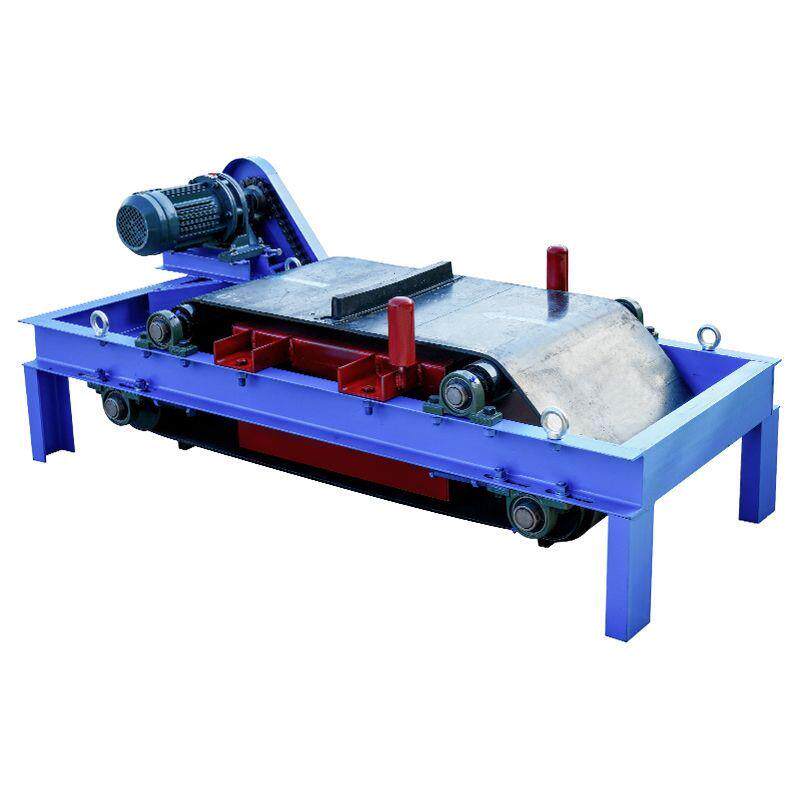
1. Product Brief — What Is the HTYD Overband Magnetic Separator?
The HTYD series overband magnetic separator — also called a suspended permanent magnet separator or self-discharging iron remover — is an automatic magnetic separation unit designed to continuously extract ferromagnetic impurities from non-magnetic bulk materials. The machine consists of four core parts: a high-intensity permanent magnet core made of NdFeB (neodymium-iron-boron), a self-cleaning discharge belt with drive rollers, a geared motor, and a robust steel frame that mounts above the main conveyor.
The working principle is simple and fully automatic. The magnet core is fixed in position while the discharge belt runs around it in a continuous loop. As mixed material passes beneath the magnet on the main conveyor, ferrous items are attracted upward and held against the belt surface. The rotating belt carries them sideways, out of the magnetic zone, where the field no longer holds them; they then fall by gravity into an iron collection bin. Suction, transfer and discharge all happen continuously — the unit effectively never stops working, and no manual cleaning is ever required.
2. Product Specifications
The HTYD series is available for conveyor belt widths from 500 mm to 2,000 mm, with rated suspension heights from 150 mm to 550 mm and material burden depths up to 500 mm. All models run on continuous duty with a compatible belt speed of up to 2.5 m/s and can remove individual ferrous pieces weighing 0.1–25 kg. Representative specifications:
|
Model
|
Belt Width (mm)
|
Suspension Height (mm)
|
Burden Depth ≤ (mm)
|
Field Strength ≥ (mT)
|
Drive Power (kW)
|
Weight (kg)
|
|
HTYD(C)-6.5
|
650
|
200
|
150
|
70
|
1.5
|
1,200
|
|
HTYD(C)-8
|
800
|
250
|
200
|
70
|
2.2
|
1,400
|
|
HTYD(C)-10
|
1,000
|
300
|
250
|
70
|
3.0
|
2,120
|
|
HTYD(C)-12
|
1,200
|
350
|
300
|
70
|
4.0
|
3,350
|
|
HTYD(C)-14
|
1,400
|
400
|
350
|
70
|
4.0
|
4,450
|
|
HTYD(C)-16
|
1,600
|
450
|
400
|
70
|
5.5
|
6,200
|
Field strength is measured at the rated suspension height and starts from 65 mT; higher-strength and electromagnetic (HTYC / HTDD) versions are available for thick burden layers or oversized ferrous items.
3. Product Advantages
- Fully automatic self-discharge: no downtime, no manual iron removal, no extra labor.
- Permanent NdFeB magnet core: near-zero magnet energy consumption with a stable, high-strength field.
- Protects downstream equipment: prevents crusher and shredder blade damage and stops longitudinal tearing of conveyor belts.
- High separation efficiency: computer-optimized dual magnetic ciHTuit for maximum iron capture.
- Continuous-duty construction: dust-proof, rain-proof and corrosion-resistant — stable even in harsh environments.
- Energy saving and low maintenance: simple structure, low failure rate; installs horizontally or at a 15–30° incline.
- Wide adaptability: fits shredder lines, sorting plants and general bulk-material handling conveyors.
4. Applications
The self-cleaning magnetic separator is used wherever ferrous metal must be removed from a moving stream of non-magnetic material:
- Scrap metal and shredder lines — iron removal after shredding, protecting downstream crushers and separators
- WEEE / e-waste recycling — iron pre-separation before eddy current and sensor-based sorting
- End-of-life vehicle (ELV) and auto shredder residue (ASR) processing
- Battery recycling plants — the most widely deployed ferrous removal technology in this sector
- Tire recycling — steel wire separation in cutting, shredding and granulating lines
- Municipal solid waste and RDF production, and construction & demolition waste sorting
- Plastic, paper and biomass recycling — feedstock purification, protecting granulators and pulpers
- Mining, aggregate and general bulk material handling
5. Get a Tailored Quote
Not sure which model fits your line? Tell us your conveyor belt width, material type, burden thickness and required throughput — our engineers will recommend the right model and send a complete quotation with drawings and installation layout within 24 hours.






 WhatsApp