Tissue paper machines depend on a component that rarely receives the attention its importance deserves: the creping doctor blade. This thin steel blade presses against the Yankee dryer at a precise angle, scraping the dried sheet from the drum and imparting the crepe structure that gives tissue its softness, bulk, and absorbency. When the blade's geometry drifts, the consequences appear immediately in the finished product — uneven crepe, inconsistent thickness, surface defects, and rising dust levels. The machine that maintains that geometry is the HUATAO Press Type Sharpener.
Why Doctor Blade Geometry Is Critical
A creping doctor blade is not a simple cutting tool. Its performance is governed by three geometric parameters: the bevel angle, the straightness of the cutting edge, and the surface finish of the working face.
The bevel angle must match the installation angle on the Yankee dryer. Industry references describe creping blades operating at bevel angles in the region of 80 degrees, with blade thickness typically around 0.025 inches. If the angle is not replicated precisely during sharpening, the blade will not crepe correctly. The sheet may adhere too aggressively, causing blade chatter and sheet damage, or release unevenly, producing inconsistent softness across the web.
Straightness matters equally. A blade that is not straight along its full length contacts the Yankee dryer unevenly. One section of the edge does more work than the others, wears faster, and reaches the end of its service life before the rest of the blade has been used. The result is more frequent blade changes, higher consumable cost, and inconsistent product quality between changes.
Surface finish on the bevel affects how the tissue releases from the blade. A rough or inconsistent finish can cause sheet defects, generate dust, and accelerate blade wear.
Why Conventional Sharpening Struggles with Long Blades
Many tissue mills sharpen doctor blades on general-purpose surface grinders, or send them to external sharpening services. Both approaches carry limitations that become more significant as blade length increases.
General-purpose grinders frequently rely on mechanical clamping. On a long, thin doctor blade, mechanical clamps introduce localized pressure points. These points can distort the blade during grinding, producing an edge that appears sharp but is not straight. The blade may also develop a slight wave along its length, which transfers directly to the creping process.
External sharpening introduces a different constraint: lead time. Doctor blades wear continuously, and sending them out for sharpening means either holding a large spare inventory or accepting production downtime. For a tissue machine running continuously, neither option is attractive.
How the HUATAO Press Type Sharpener Addresses These Problems
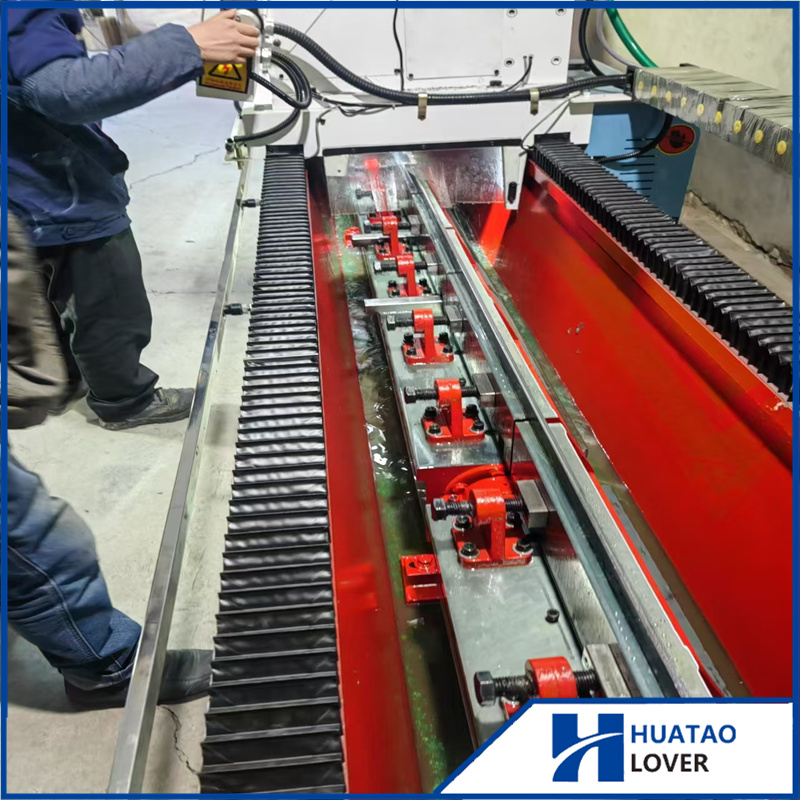
The HUATAO Press Type Sharpener is designed specifically for long, thin blades where holding stability and edge straightness are the limiting requirements.
Full-surface electromagnetic chuck. Instead of mechanical clamps, the blade is secured by an electromagnetic chuck that covers the full blade length. The magnetic hold is uniform, eliminating the localized pressure points that cause distortion. Thin spring steel blades remain flat throughout the grinding cycle, and the finished edge is straight from head to tail.
Precision linear guideways. The grinding head travels on precision linear guideways rather than sliding blocks. This produces a straight edge with straightness tolerances measured in fractions of a millimetre per metre, and reduces the vibration that causes chatter marks on the bevel.
Adjustable worktable angle. The worktable angle is adjustable, allowing the original bevel to be replicated precisely for each blade type and thickness. Operators can set and lock the angle for repeatable results across a batch.
Integrated coolant system. Continuous coolant flow at the grinding point prevents the blade from overheating. This preserves the hardness achieved during the original heat treatment and prevents the micro-cracks that lead to premature blade failure. For thin spring steel blades, thermal protection is not optional.
PLC control and automatic cycles. Grinding parameters — number of passes, depth per pass, and carriage speed — are preset and executed automatically. Every blade in a batch is ground to the same specification regardless of operator skill or shift.
Model Range and Capacity
HUATAO manufactures the press type sharpener across a range of grinding lengths to match different blade inventories. The HT800Mm Automatic Sharpener suits compact blade sets. The HT1600Mm Automatic Sharpener covers general blades, while the HT2300Mm Automatic Sharpener and HT3200Mm Automatic Sharpener address longer blade sets including full-width tissue machine doctor blades. For operations requiring a fully automated workflow, the Fully Automatic Linear Knife Sharpener provides programmable cycles with minimal operator input.
Full specifications are available on the Industrial Knife Grinding Machine product page.
Application Beyond Tissue Machines
The same geometric requirements apply to other long, thin blades in paper converting and related industries. Paper cutter knives, slitter blades, and guillotine blades all depend on straightness and consistent bevel geometry. The HUATAO Press Type Sharpener is configured to handle this wider blade inventory, allowing a single machine to serve multiple blade types within a facility.
For operations processing recycling equipment blades, the machine also restores granulator and shredder knives. Material selection guidance is available in How To Choose The Right Plastic Crusher Blades SKD11 D2 DC53 And LD.
The Economics of In-House Sharpening
The financial case for in-house sharpening rests on three variables.
Blade life. A blade sharpened to precise geometry before it becomes badly dull requires less material removal per cycle. More sharpening cycles before replacement means lower blade cost per tonne of tissue produced.
Downtime. In-house sharpening reduces lead time from days to hours. Blade changes can be scheduled during planned stoppages rather than forced by a quality problem.
Consistency. A machine with PLC control and electromagnetic holding produces the same edge geometry every time. Sheet quality stabilizes, and the variability that causes grade changes and waste is reduced.
For tissue mills where blade maintenance is currently outsourced or performed on general-purpose equipment, the payback period on a dedicated press type sharpener is typically measured in months rather than years.
Maintenance of the Sharpener Itself
The HUATAO Press Type Sharpener requires routine maintenance to preserve its accuracy. The electromagnetic chuck should be cleaned regularly to maintain consistent holding force. The coolant system should be checked for flow rate and fluid condition. The grinding wheel should be dressed and replaced according to schedule. Guideways should be lubricated and inspected for wear.
Operational discipline matters as much as machine maintenance. Treating sharpening as scheduled maintenance rather than reactive repair — with a rotating blade inventory — means blade changes happen during planned stoppages. Detailed guidance is available in Optimizing Shredder Blade Usage A Comprehensive Guide To Efficiency And Longevity and Do You Know How To Maintenance And Care Of The Shredder Blade.
The Point
Creping doctor blades are a small component in a large machine, but they determine the quality of the finished product. The sharpening process determines how well those blades perform.
The HUATAO Press Type Sharpener exists because long, thin blades require a different approach to holding and grinding. Mechanical clamps distort them. General-purpose grinders cannot hold straightness across their full length. A machine designed for the application can.
If your tissue machine is experiencing inconsistent sheet quality, rising dust levels, or blade changes more frequent than expected, the problem may not be the blade. It may be the geometry — and the machine that failed to restore it.
Contact us:
Marketing@huataogroup.com
Tel:+86 13383116640 (WeChat/WhatsApp)
http://wa.me/13383116640
Website: www.huataoshredder.com
#HUATAOPressTypeSharpener #PressTypeSharpener #DoctorBladeSharpening #TissuePaper #KnifeGrindingMachine #BladeMaintenance #PaperIndustry #PrecisionGrinding



 WhatsApp