

Primary size reduction is the stage that determines whether every downstream process in a recycling line can operate efficiently. The Double Shaft Shredder occupies this position in the majority of industrial recycling configurations, accepting bulky, irregular, and contaminated feedstock and reducing it to a form that magnetic separators, eddy current separators, and granulators can process effectively. Understanding what the Double Shaft Shredder does, where it fits in the process chain, and how to configure it correctly is fundamental to designing a recycling operation that performs consistently.
Where the Double Shaft Shredder Sits in the Process Chain
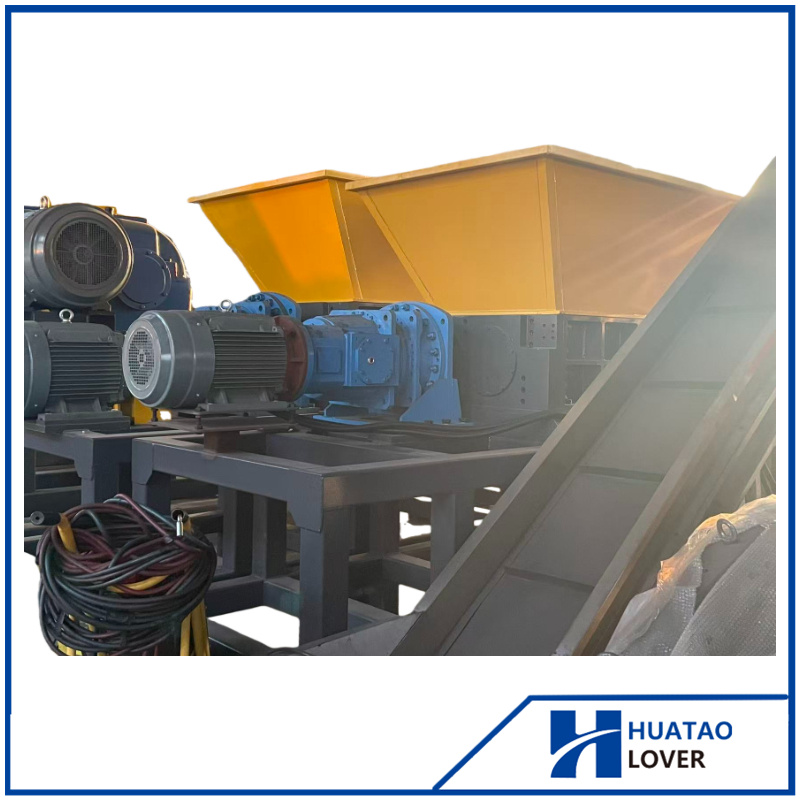
A recycling line follows a predictable sequence: feedstock preparation, primary size reduction, secondary size reduction, separation, and output handling. The Double Shaft Shredder operates at the primary size reduction stage, positioned immediately after feedstock reception and before any separation or fine-reduction equipment.
This position is not arbitrary. Primary shredding must occur before separation because separation technologies require liberated material. Ferrous magnets, eddy current separators, and screening systems cannot function efficiently when fed whole tires, complete cable bundles, or intact plastic containers. The Double Shaft Shredder performs the liberation step, opening the material structure and creating a homogeneous feed stream for the equipment that follows.
In a typical tire recycling configuration, the Double Shaft Shredder reduces whole tires to 50–150 mm chips. These chips then pass to a steel liberator and overband magnet for ferrous removal before continuing to granulation. In plastic recycling, the Double Shaft Shredder handles bales, purgings, and bulky molded parts, producing a particle size suitable for washing lines and granulators. In metal recycling, it reduces end-of-life vehicles and mixed scrap prior to magnetic and eddy current separation.
Model Selection: Matching the Double Shaft Shredder to the Application
Huatao manufactures the Double Shaft Shredder in several capacity tiers, each suited to different throughput requirements and feedstock characteristics.
The 800 Type Double Shaft Shredder is the entry point in the range, appropriate for smaller operations and moderate throughput. The 1000 Type Double Shaft Shredder provides a mid-range option for growing facilities, while the 1200 Type Double Shaft Shredder addresses higher-capacity requirements. A 600 Type Double Shaft Shredder is also available for compact installations.
Model selection should be driven by three factors: the maximum feed size the machine must accept, the required throughput in tonnes per hour, and the target output particle size. A larger model does not automatically deliver better results if the output size requirement is finer than the machine is configured to produce; in that case, the Double Shaft Shredder should be paired with a secondary shredder.
The Two-Stage Configuration: Double Shaft Shredder Plus Single Shaft Shredder
Many recycling operations achieve better results by combining two shredding technologies rather than relying on one machine to perform the entire size reduction task. A Single Shaft Shredder is frequently installed downstream of the Double Shaft Shredder to provide controlled secondary reduction.
The division of labour is straightforward. The Double Shaft Shredder handles the difficult work of gripping and tearing bulky, tangled, or irregular material. Its counter-rotating shafts and high torque allow it to process feedstock that would stall a single-shaft machine. The Single Shaft Shredder then takes the pre-reduced material and applies controlled shearing against a fixed counter knife with a hydraulic pusher, producing consistent output through a screen.
Available Single Shaft Shredder models include the HT600 series, the 800 type, the HT 1000 type, and the 1200 type. Each model is configured to accept pre-shredded material from the Double Shaft Shredder and reduce it to the particle size required by downstream separation equipment.
Maintenance and Operational Life
The Double Shaft Shredder is a high-wear machine by nature, and its service life depends on disciplined maintenance. A structured programme covering daily visual inspection of the cutting chamber, hydraulic system checks, and screen inspection will identify problems before they cause unplanned stoppages. Our twin shaft shredder maintenance guide sets out the recommended schedule in detail.
A Twin Shaft Shredder Maintenance Guide Extend Service Life Cut Operational Cost is available for operators who require a formal maintenance framework. Blade condition is the single most important variable: dull blades increase energy consumption, reduce throughput, and place additional load on bearings and drive components. Maintaining a Single Shaft Shredder Blade inventory and a sharpening schedule is essential.
For operations that need to source replacement tooling, Huatao Wear Resistant Customization Shredder Blades are available in application-specific configurations.
Integration with Downstream Equipment
The output of the Double Shaft Shredder feeds directly into the separation stage of the recycling line. In metal and e-waste applications, this means magnetic separation followed by Eddy Current Separator technology for non-ferrous recovery. In plastic and tire applications, it means screening and granulation.
For complete line design, a Waste Recycling Production Line can be configured around the Double Shaft Shredder as the primary stage, with all downstream equipment selected to match the shredder's output characteristics.
Contact us:
Marketing@huataogroup.com
Tel:+86 13383116640 (Wechat/whatsapp)
http://wa.me/13383116640
Website:www.huataoshredder.com
#DoubleShaftShredder #PrimarySizeReduction #RecyclingEquipment #TwinShaftShredder #IndustrialShredder #Huatao #CircularEconomy #WasteManagement #ShredderMaintenance #RecyclingLine
can not be empty
can not be empty

HUATAO GROUP - Recycling Machine and Spare parts
ADD : No.298 Zhonghua North Street, Shijiazhuang 050000 China.
TEL : +86 13383116640
EMAIL :marketing@huataogroup.com
 WhatsApp & WeChat : +86 13383116640