

Secondary size reduction is the stage where output consistency is determined. While primary shredding liberates material and reduces bulk, secondary shredding produces the controlled particle size that separation equipment and downstream processing require. The Single Shaft Shredder is the standard technology for this stage, offering precise control over output size through interchangeable screens and a hydraulic feed system that maintains consistent throughput.
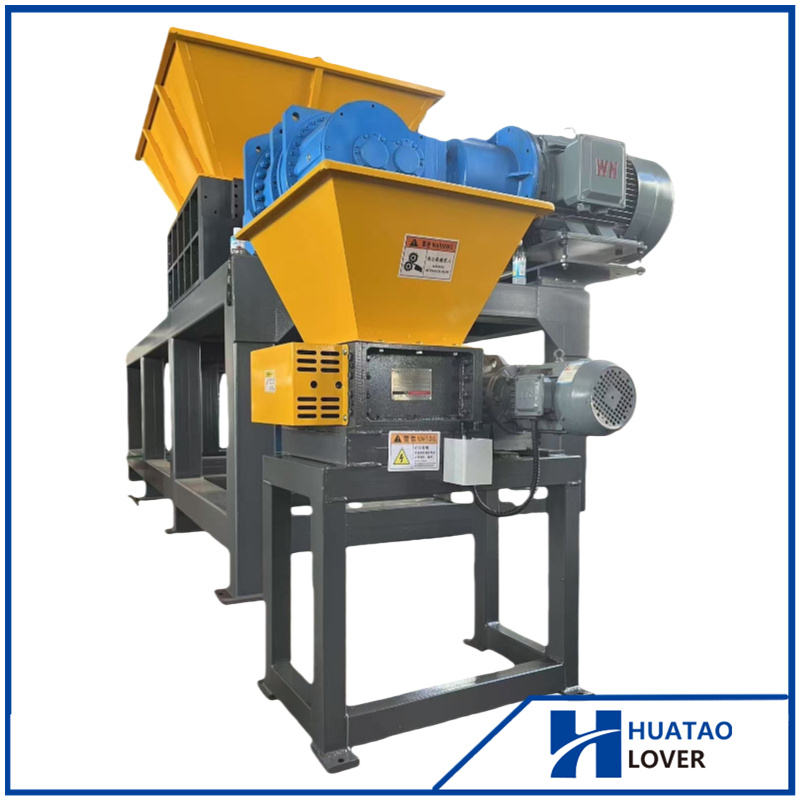
The Operating Principle of the Single Shaft Shredder
The Single Shaft Shredder differs from primary shredding equipment in a fundamental way: it uses a single rotating rotor equipped with cutting blades that work against a fixed counter knife, rather than two counter-rotating shafts. Material is fed into the cutting chamber by a hydraulic pusher, which advances the feedstock at a controlled rate against the rotor.
The output size is determined by the screen installed beneath the rotor. Material remains in the cutting chamber until it is reduced sufficiently to pass through the screen apertures. This mechanical constraint is what gives the Single Shaft Shredder its defining capability: consistent, predictable output size regardless of variations in the incoming feedstock.
Model Range and Selection Criteria
Huatao manufactures the Single Shaft Shredder across a range of capacities to match different throughput and output requirements.
The Single Shaft Shredder HT600 Series is suited to lower-capacity operations and compact installations. The Single Shaft Shredder 800 Type provides a mid-range option, while the Single Shaft Shredder HT 1000 Type and the Single Shaft Shredder 1200 Type address higher throughput requirements.
Selection should be driven by the required output particle size, the throughput in tonnes per hour, and the characteristics of the material feeding into the Single Shaft Shredder from the primary stage. If the incoming material is highly variable in size, a larger rotor diameter and a more powerful hydraulic pusher may be required to maintain consistent feeding.
Screen Configuration and Output Control
The screen is the primary control variable for the Single Shaft Shredder. Screen apertures are selected according to the downstream process requirement. For granulator feed, a coarser screen may be appropriate; for applications requiring finer output before separation, a tighter screen aperture is used.
Screen changes are a routine part of operating the Single Shaft Shredder, and the machine is designed to allow screens to be exchanged without disturbing the rotor alignment. Operators should maintain a stock of screens in the apertures relevant to their production requirements so that changeover does not become a bottleneck.
Blade Maintenance and the Single Shaft Shredder Blade
The Single Shaft Shredder Blade is the component that determines cutting performance. As blades wear, the clearance between the rotor blades and the counter knife increases, which reduces cutting efficiency and increases energy consumption. Regular inspection and timely sharpening or replacement are essential.
Blade sharpening should be performed on a precision knife grinder to restore the correct cutting geometry and maintain uniform blade height. Uneven blade height causes rotor imbalance and reduces cutting efficiency across the rotor width. A dedicated Industrial Knife Grinding Machine is the appropriate equipment for this task.
For operations seeking replacement blades, Huatao Wear Resistant Customization Shredder Blades are manufactured in application-specific grades. Guidance on blade selection is available in our article on How To Choose The Right Plastic Crusher Blades SKD11 D2 DC53 And LD.
Integration with Primary Shredding
The Single Shaft Shredder is typically installed downstream of a primary shredder. In tire and cable recycling applications, a two-stage configuration is standard: a Double Shaft Shredder performs primary reduction, and the Single Shaft Shredder performs secondary reduction.
A Double Shaft Shredder Machine is available for the primary stage, with models including the 1200 Type Double Shaft Shredder, 1000 Type Double Shaft Shredder, and 800 Type Double Shaft Shredder. A 600 Type Double Shaft Shredder is also available for smaller installations.
This two-stage arrangement allows each machine to operate within its design parameters. The primary shredder handles the difficult gripping and tearing work, while the Single Shaft Shredder focuses on producing the controlled output size that downstream equipment requires.
Downstream Equipment and Complete Lines
The output of the Single Shaft Shredder feeds the separation stage of the recycling line. In metal recovery applications, this means magnetic separation followed by Eddy Current Separator technology. In plastic recycling, the shredded material passes to washing and granulation equipment.
For complete line design, a Waste Recycling Production Line can be configured with the Single Shaft Shredder as the secondary reduction stage. Application-specific configurations include the Scrap Metal Recycling Production Line, the PET Polyethylene Terephthalate Bottle Recycling Line, and the Waste Tire Crushing And Grinding Production Line.
Contact us:
Marketing@huataogroup.com
Tel:+86 13383116640 (Wechat/whatsapp)
http://wa.me/13383116640
Website:www.huataoshredder.com
#SingleShaftShredder #SecondarySizeReduction #FineShredding #ShredderBlade #RecyclingEquipment #Huatao #ScreenConfiguration #RecyclingLine #WasteProcessing #CircularEconomy
can not be empty
can not be empty

HUATAO GROUP - Recycling Machine and Spare parts
ADD : No.298 Zhonghua North Street, Shijiazhuang 050000 China.
TEL : +86 13383116640
EMAIL :marketing@huataogroup.com
 WhatsApp & WeChat : +86 13383116640