Metal scrap does not arrive in a form that separation equipment can process. End-of-life vehicles, white goods, structural steel, cable bundles, and mixed industrial assemblies arrive as engineered structures — metals joined to plastics, rubber, glass, and one another by fasteners, adhesives, and mechanical interlocks. A magnetic separator cannot extract steel from a vehicle chassis that has not been opened. An eddy current separator cannot eject aluminium from a housing that still contains it. The first task in any metal recycling operation is not separation. It is liberation. And liberation is the function of the primary reduction stage within the HUATAO Metal Recycling Line.
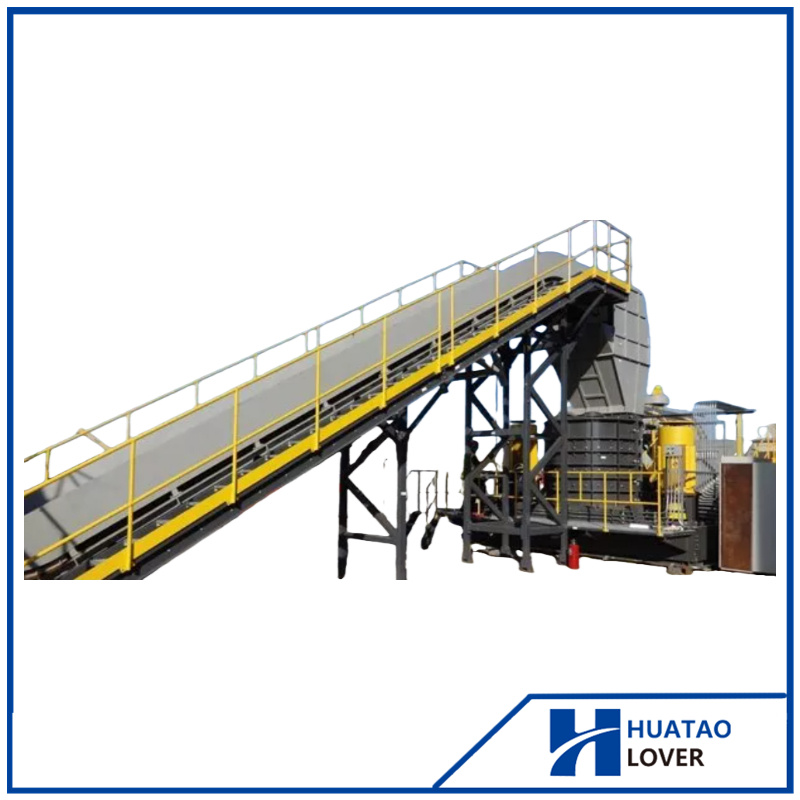
Why Separation Requires Liberation First ?
The sequence of a metal recycling line follows a predictable logic: feedstock reception, primary size reduction, ferrous separation, non-ferrous separation, secondary reduction where required, and output handling. The HUATAO Metal Recycling Line is configured around this sequence, with each stage performing a function that the next stage depends on.
The primary reduction stage is performed by the Double Shaft Shredder. Its role is not simply to reduce volume. It is to break the mechanical connections between materials — to open the structure of the scrap so that downstream equipment can distinguish and separate individual fractions. Counter-rotating shafts, fitted with hardened cutting blades, grip the material and apply sustained shearing force. The result is a liberated mixture: ferrous fragments, non-ferrous pieces, and non-metallic residue, all reduced to a particle size that separation equipment can handle.
Without this stage, the line cannot function. Magnetic separators, eddy current separators, and screening systems all operate on liberated particles. Feed them intact assemblies, and recovery rates fall while operating costs rise.
The Primary Stage: Double Shaft Shredder Configuration
The HUATAO Metal Recycling Line uses the Double Shaft Shredder as its primary reduction unit. The machine is manufactured in several capacity tiers to match different throughput requirements. The 600 Type Double Shaft Shredder serves compact installations. The 800 Type Double Shaft Shredder addresses mid-range operations. The 1000 Type Double Shaft Shredder and 1200 Type Double Shaft Shredder handle higher throughput requirements. Full specifications are on the Double Shaft Shredder Machine page.
For metal applications specifically, the machine can be configured with wear-resistant alloy blades and reinforced shafts. A hydraulic pusher improves feeding efficiency and throughput. Blade thickness and screen aperture are customizable to meet different output requirements .
The Two-Stage Configuration for Demanding Scrap
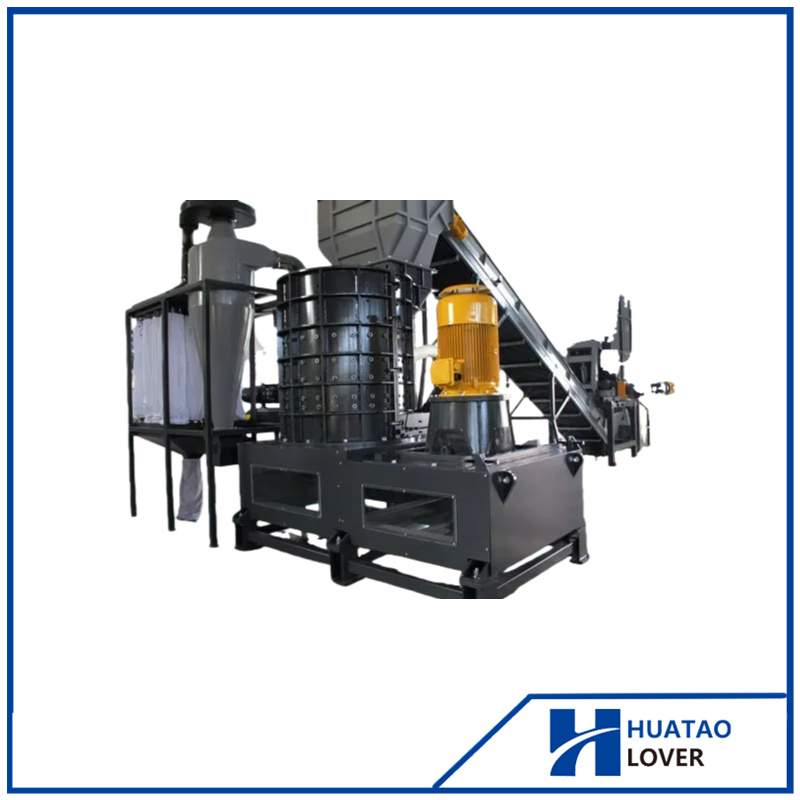
Some metal streams require finer liberation than a single shredding stage can achieve. For these applications, the HUATAO Metal Recycling Line employs a two-stage configuration: a Double Shaft Shredder for primary reduction, followed by a Single Shaft Shredder for controlled secondary reduction.
The division of labour is deliberate. The Double Shaft Shredder handles the difficult work of gripping and tearing bulky, tangled, and irregular material. The Single Shaft Shredder then applies controlled shearing against a fixed counter knife with a hydraulic pusher, producing consistent output through an interchangeable screen. Available models include the Single Shaft Shredder HT600 Series, the 800 Type, the HT 1000 Type, and the 1200 Type.
This configuration is particularly relevant for end-of-life vehicle processing, where the mix of ferrous and non-ferrous metals, plastics, glass, rubber, and residual fluids requires staged liberation to achieve high-purity output fractions.
Separation: Ferrous and Non-Ferrous Recovery
Once material has been liberated, separation becomes viable. The HUATAO Metal Recycling Line integrates magnetic separation for ferrous recovery and eddy current separation for non-ferrous recovery.
Magnetic separation removes iron and steel from the shredded stream. This stage protects downstream equipment and produces a saleable ferrous fraction. The recovered ferrous material is typically sold to steel mills as shredder feed.
Eddy current separation recovers aluminium, copper, brass, and zinc. An Eddy Current Separator uses a high-speed magnetic rotor to induce eddy currents in conductive particles, generating a repulsive force that ejects non-ferrous metals from the material stream. The effectiveness of this stage depends directly on the quality of liberation achieved upstream.
For complete metal recycling configurations, the Scrap Metal Recycling Production Line page sets out the integrated system, including shredders, magnetic separators, eddy current separators, and balers. Detailed engineering guidance on configuring the line for complex feedstocks is available in HUATAO Configuring the Metal Recycling Line for Complex Feedstocks: From ELVs to E-Waste, which addresses end-of-life vehicles, cable scrap, and electronic waste applications .
Feedstock-Specific Considerations
The HUATAO Metal Recycling Line is configured to the specific material stream, not to a generic specification.
1 End-of-life vehicles. Processing begins with depollution — controlled removal of fluids, batteries, and hazardous components. The depolluted vehicle is then fed into the line for shredding, magnetic separation, and advanced separation of non-ferrous metals and plastics. Air classification systems separate light materials from heavy metals before ferrous and non-ferrous recovery .
2 Cable and wire scrap. The intimate bonding between metal conductors and plastic insulation requires specialized processing. A dedicated configuration integrates shredding, granulation, and density separation to liberate and recover copper and aluminium from cable waste .
3 Mixed industrial scrap. Structural steel, white goods, and mixed assemblies are processed through the primary shredder, with output routed to magnetic and eddy current separation according to the composition of the feed.
Maintenance and Blade Condition
The HUATAO Metal Recycling Line operates in a high-wear environment. Metal feedstock accelerates wear more than almost any other material, and blade condition is the single most important variable affecting energy consumption, throughput, and bearing load.
A structured maintenance programme is essential. The Twin Shaft Shredder Maintenance Guide Extend Service Life Cut Operational Cost sets out the recommended schedule. Blade rotation at planned intervals extends service life, and timely sharpening maintains cutting efficiency.
An Industrial Knife Grinding Machine restores blades to specification, and replacement blades are available as Huatao Wear Resistant Customization Shredder Blades. For operations processing metal specifically, the Liberation Before Separation: How HUATAO Double Shaft Shredder Unlocks Value in Metal Recycling article provides a detailed treatment of the primary stage's role .-4
The Point
A metal recycling line succeeds or fails at its primary reduction stage. Separation technologies — magnets, eddy current separators, screens — can only recover what has been liberated. The HUATAO Metal Recycling Line is configured around this principle: primary liberation by Double Shaft Shredder, controlled secondary reduction where required, and separation matched to the liberated feed.
For operators processing end-of-life vehicles, mixed scrap, or cable waste, the line is the mechanism that converts a disposal problem into saleable ferrous and non-ferrous fractions.
Contact us:
Marketing@huataogroup.com
Tel:+86 13383116640 (WeChat/WhatsApp)
http://wa.me/13383116640
Website: www.huataoshredder.com
#HUATAO #MetalRecyclingLine #ScrapMetal #DoubleShaftShredder #EddyCurrentSeparator #FerrousRecovery #CircularEconomy #WasteManagement #RecyclingEquipment #MetalRecovery



 WhatsApp