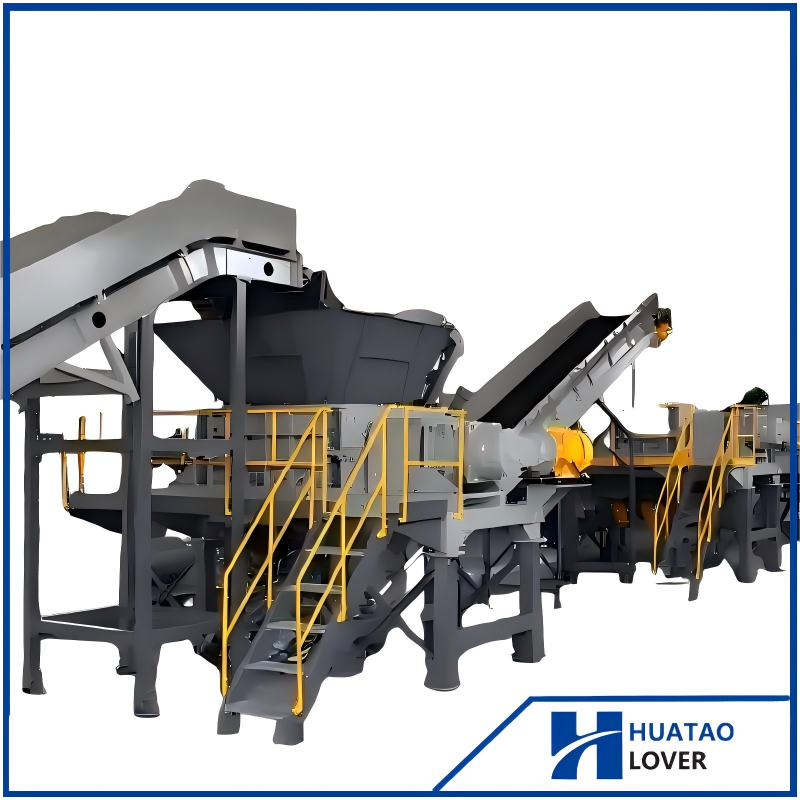
A whole tyre is not a material. It is a structure. Rubber compound, steel bead wire, steel belts, and textile reinforcement are bonded into a single engineered assembly designed to survive tens of thousands of kilometres of road contact. Recovering the rubber, steel, and textile from that assembly requires breaking it apart. And the machine that performs the first, most difficult step in that process is the Double Shaft Shredder within the HUATAO Tyre Recycling Line .
This article examines the complete line — stage by stage, from primary reduction to final product — and the engineering logic that connects them.
Why Whole Tyres Resist Recycling ?
Tyres are among the most difficult materials in any recycling stream. They are large, heavy, and flexible. They contain steel reinforcement that resists cutting and damages conventional blades. They are shaped in ways that make them difficult to feed into machinery. And they arrive in sizes ranging from passenger car tyres to massive OTR tyres used in mining and construction .
The difficulty is physical rather than chemical. Vulcanised rubber deforms under impact rather than fracturing. A high-speed hammer mill striking a tyre transfers energy into deformation, not fracture. The tyre bounces rather than breaks. This is why high-speed machines struggle with whole tyres, and why the HUATAO Tyre Recycling Line is built around a different principle.
Stage One: Primary Reduction and the Liberation Principle
The first stage in the line is primary reduction, performed by the Double Shaft Shredder. Two counter-rotating shafts, fitted with hardened cutting blades, grip the tyre and tear it apart through shear. Shaft speeds typically run in the range of 10 to 40 RPM, with torque multiplied through planetary gear reducers. There is no high-speed impact involved .
The distinction between shear and impact matters more than it might appear. Impact-based shredders rely on a single high-energy strike. When that strike meets the flexible, energy-absorbing structure of a tyre, the result is unpredictable: the tyre may deform rather than break, the blade may bounce off, or the machine may stall entirely. The Double Shaft Shredder applies sustained tearing force instead. The counter-rotating shafts grip the tyre and pull it into the cutting chamber, where the blades progressively shear through the rubber and steel until the material yields .
The output is tyre chips, typically in the range of 50 to 150 mm. But the purpose of this stage is not simply volume reduction. It is liberation — breaking the mechanical connections between rubber, steel, and textile so that downstream equipment can separate them. Without effective primary shredding, the steel remains embedded in the rubber and cannot be recovered efficiently .
The HUATAO Double Shaft Shredder is configured for the specific demands of tyre processing. The machine is manufactured in several capacity tiers. The 800 Type Double Shaft Shredder suits mid-range operations. The 1000 Type Double Shaft Shredder addresses growing facilities, while the 1200 Type Double Shaft Shredder handles higher capacity requirements. A 600 Type Double Shaft Shredder is available for compact installations. Full specifications are on the Double Shaft Shredder Machine page.
For tyre processing specifically, the shredder blade material is typically D2, with customization available on request to reach the best running performance. The shredded output reaches 50–70 mm, ready for delivery to the next process for smaller size production .
Stage Two: Steel Liberation and Magnetic Separation
Once the tyres have been reduced to chips, the steel fraction must be extracted. This is performed by magnetic separation — overband magnets or magnetic drums positioned over the conveyor carrying the shredded material. The magnet attracts and holds ferrous particles, diverting them into a separate collection stream.
The engineering significance of this stage extends beyond steel recovery. It also protects downstream equipment. Steel that remains in the rubber stream will damage granulator blades and contaminate the final rubber product. The recovered steel is a saleable commodity in its own right, suitable for resale to steel mills and foundries. Its value depends on purity, which depends on the degree of liberation achieved at the shredding stage.
Where a finer particle size is required before granulation, a Single Shaft Shredder can be configured for secondary reduction. The machine applies controlled shearing against a fixed counter knife with a hydraulic pusher, producing consistent output through an interchangeable screen. Available models include the Single Shaft Shredder HT600 Series, the 800 Type, the HT 1000 Type, and the 1200 Type.
Stage Three: Granulation and Crumb Rubber Production
For lines producing crumb rubber, the shredded and steel-free chips proceed to granulation. Granulators and grinding mills reduce the chips to crumb rubber in the range of 10 to 30 mesh, depending on the target application. Ambient grinding produces irregular, rough-surfaced particles that bond well in rubberised asphalt. Cryogenic grinding, which uses liquid nitrogen to freeze the rubber before pulverising, produces finer, smoother particles with reduced contamination.
The Rubber Powder Grinder serves as the core crushing equipment in the intermediate stage of the tyre recycling line. It is an open-type, dual-roll machine. Two chilled alloy cast-iron rolls are mounted in parallel and rotate toward each other at different linear speeds, with a speed ratio ranging from 1:1.30 to 1:1.38. This speed differential generates powerful shear and compressive forces within the roll nip, tearing rubber chunks into granules or powder while facilitating the separation of rubber from steel cords and bead wires .
The machine features hollow rolls that allow circulation of steam or cooling water to control roll surface temperature, preventing rubber scorching under heavy-duty conditions. The adjustable roll nip, up to 8–15 mm, controls output particle size for precise compatibility with downstream grinding and screening. Available models range from the compact XKP-400 to the large-scale XKP-610, with production capacities from 200 kg/h to 2,500 kg/h depending on the model .-4
Crumb rubber applications include rubber-modified asphalt, playground surfaces, sports tracks, moulded rubber products, and filler in new rubber compounds. Each application has its own particle size and purity specification, and the granulation stage is configured to meet it.
Stage Four: Alternative Outputs — TDF and Pyrolysis Feedstock
Not every tyre recycling line produces crumb rubber. Two alternative output routes are common, and the HUATAO Tyre Recycling Line can be configured for either.
Tyre-Derived Fuel (TDF). For applications where material recycling is not feasible, shredded tyre chips serve as tyre-derived fuel. TDF has a calorific value of approximately 8,000 kcal/kg, comparable to heavy fuel oil and higher than coal. It is used in cement kilns and industrial boilers as a partial substitute for fossil fuels.
Pyrolysis Feedstock. Shredded tyre chips also feed pyrolysis reactors, where rubber is broken down into oil, gas, and recovered carbon black. Waste tyres can be transferred to fuel oil and combustible gas through pyrolysis, and these chemical substances can be used as industrial raw material or energy . The uniformity of the shredder output affects heat transfer consistency and reaction conditions inside the reactor — making chip quality an economic variable in pyrolysis yield, not just a technical one.
In both cases, the shredding stage determines the quality of the feedstock that reaches the thermal process. Uniform chips produce predictable results. Inconsistent chips produce variability that the reactor cannot compensate for.
The Bead Wire Decision
One design decision has a disproportionate effect on line performance and maintenance cost: whether bead wire is removed before shredding.
Bead wire is high-tensile steel wound tightly into the sidewall. When it enters the shredder, it imposes the highest shock loads of any tyre component. Removing it beforehand — using a debeading machine — reduces blade wear, lowers energy consumption, and extends the interval between maintenance interventions. Some operators choose to shred whole tyres without debeading. This is feasible with a robustly specified machine, but the maintenance cost is higher. The decision should be based on total operating cost, not capital cost alone.
Maintenance: The Variable That Determines Everything
The HUATAO Tyre Recycling Line operates in a high-wear environment. Steel reinforcement is abrasive, and shock loads from unshreddable inclusions can damage blades and shafts.
Blade condition is the single most important variable. Dull blades increase energy consumption, reduce throughput, and produce inconsistent chip size — which degrades separation efficiency downstream. Shredder blades are the heart of the shredder machine. Different blade types are available — 2-claw, 3-claw, 4-claw — and can be designed according to customer request. The blade material used for tyre shredding is normally D2, customizable as per customer request to reach the best running performance .
A structured maintenance programme is essential. The Twin Shaft Shredder Maintenance Guide Extend Service Life Cut Operational Cost sets out the recommended schedule. An Industrial Knife Grinding Machine restores blades to specification, and replacement blades are available as Huatao Wear Resistant Customization Shredder Blades.
Blade care guidance is available in Optimizing Shredder Blade Usage A Comprehensive Guide To Efficiency And Longevity, The Most Important Part Of Shredder Shredder Blades, and Do You Know How To Process With Waste Tires .
The Economics of a Tyre Recycling Line:
The economic case for a tyre recycling line rests on the value of the resources it liberates.
A whole tyre has little market value. Shredded tyre chips have more. Separated steel and crumb rubber have significantly more. The line is the mechanism that moves material up that value chain.
Three factors determine the return on investment.
1 Recovery rate — how much of the tyre's mass is converted into saleable product, rather than residue or waste. This depends primarily on the liberation and separation stages.
2 Output quality — the purity of the recovered steel and rubber fractions determines the price they command.
3 Operating cost — energy consumption, blade replacement frequency, and downtime all affect the cost side of the equation.
The regulatory environment also plays a role. Extended Producer Responsibility schemes in regions including Canada, Germany, and Japan hold manufacturers responsible for the lifecycle of their products, creating steady supply chains for recycling infrastructure. The EU's Ecodesign for Sustainable Products Regulation, with subordinate legislation for tyres expected in the coming years, is driving demand for higher-quality recycled materials.
For complete line configurations, see The Complete Tire Recycling Line Engineering A Sustainable Future For End-of-Life Tyres and Waste Tire Crushing And Grinding Production Line. A value-chain perspective is available in Huatao Double Shaft Shredders Driving The Circular Economy In Tire Recycling. Broader multi-stream applications are covered in the Waste Recycling Production Line overview.
The Point :
Waste tyres are not a disposal burden. They are a resource stream containing rubber, steel, and textile that can be recovered and returned to productive use.
The HUATAO Tyre Recycling Line is the mechanism that performs that recovery — from primary liberation through separation, granulation, and final product formation. Each stage is configured to the requirement of the next, and the whole line is configured to the output you intend to sell.
That is what a recycling line is. Not a collection of machines. A coordinated system.
Contact us:
Marketing@huataogroup.com
Tel:+86 13383116640 (WeChat/WhatsApp)
http://wa.me/13383116640
Website: www.huataoshredder.com
#HUATAO #TyreRecyclingLine #TyreRecycling #TireRecycling #DoubleShaftShredder #CrumbRubber #TDF #CircularEconomy #WasteManagement #RecyclingEquipment



 WhatsApp